Birmingham sits on a mix of glacial till, river terrace deposits, and Mercia Mudstone. That variation means subgrade strength can change within a single street. We run CBR studies for road design in Birmingham to give you the soaked and unsoaked values that actually govern pavement thickness. No generic tables — we test the material you will compact. Before setting up the test it is worth checking the subgrade classification to see if the soil is cohesive or granular, because that changes how we interpret the penetration curve. We also recommend a Proctor compaction beforehand to match field density conditions in the lab.
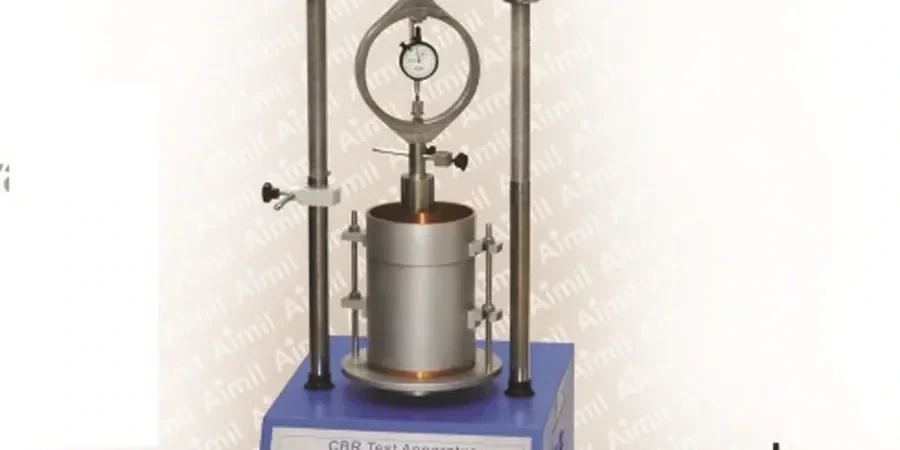
In Birmingham we have seen soaked CBR values below 3% in glacial till, which directly doubles the required pavement thickness compared to a 15% CBR subgrade.
Scope of work in Birmingham
Live process video
Critical ground factors in Birmingham
Birmingham expanded rapidly during the Industrial Revolution, with much of the city built on soft alluvial deposits along the River Rea and its tributaries. These areas now carry heavy traffic loads that the original road builders never anticipated. If the CBR is overestimated by even 2 %, the pavement will rut and crack within two winters. We have seen residential roads fail after five years because the design assumed a 5 % CBR on clay that actually gave 2.5 % after wetting. A proper CBR study for road design in Birmingham catches those low values before the asphalt goes down.
This service complements our laboratory testing work for a complete project analysis.
Our services
We cover the full CBR workflow from sampling to reporting, always with UKAS-accredited methods.
Laboratory CBR Test (Soaked & Unsoaked)
Compaction at OMC, four-day soak, penetration test at 1.27 mm/min. Results reported at 2.5 and 5.0 mm with correction curves if needed. Suitable for cohesive and granular subgrades.
In-Situ CBR with Dynamic Cone Penetrometer
Field DCP test correlated to CBR using standard conversion (CBR = 292 / DCP^1.12). Ideal for existing road pavements and subgrades where undisturbed samples are hard to get.
CBR-Based Pavement Design Support
We take your CBR results and produce a recommended pavement structure following DMRB CD 225. Includes traffic loading categories and subgrade sensitivity analysis for Birmingham clay.
Q&A
How much does a CBR study for road design cost in Birmingham?
A standard laboratory CBR test including sample preparation and four-day soak typically costs between £120 and £260 per sample. The range depends on the number of samples and whether you need soaked or unsoaked tests. We provide a fixed quote after receiving the soil type and project volume.
What is the difference between soaked and unsoaked CBR?
The soaked CBR simulates worst-case moisture conditions after the subgrade has been saturated for four days. Unsoaked CBR reflects the strength at optimum moisture content. For Birmingham clay the soaked value can be 40-60 % lower than the unsoaked, so pavement design should always use the soaked result unless the road is in a covered area with controlled drainage.
Can I use the CBR value from a desktop study or nearby project?
Not reliably. Glacial till in Birmingham varies laterally — one borehole can show 5 % CBR and another 50 m away shows 2 %. The Mercia Mudstone also weathers unevenly. We always recommend at least one CBR test per 500 m of road alignment, with additional tests where the geology changes.
How long does the CBR test take and when do I get results?
The soaked test requires a four-day soak plus compaction and sample preparation, so the turnaround is around 7 working days. The unsoaked test can be completed in 3 working days. We issue a signed test certificate with the penetration curve and the CBR value at both 2.5 mm and 5.0 mm penetration.