Walk into any geotechnical lab in Birmingham and you will see a load frame with a cylindrical soil sample placed between two parallel platens. That is the unconfined compression test (UCS) in action — a straightforward yet powerful method to determine the undrained shear strength of cohesive soils. In the West Midlands, where much of the subsurface consists of glacial till and Mercia Mudstone formations, the UCS test is frequently specified for small to medium-sized developments. The test applies a steadily increasing axial load until the sample fails, giving engineers a direct measure of the soil's strength without the need for confining pressure. This is particularly useful for quick assessments on sites across Birmingham, from the city centre redevelopments near the Bullring to residential expansions in Sutton Coldfield. The test follows the procedures outlined in BS 1377-7:1990 and is often paired with a clasificación de suelos to fully characterise the material.
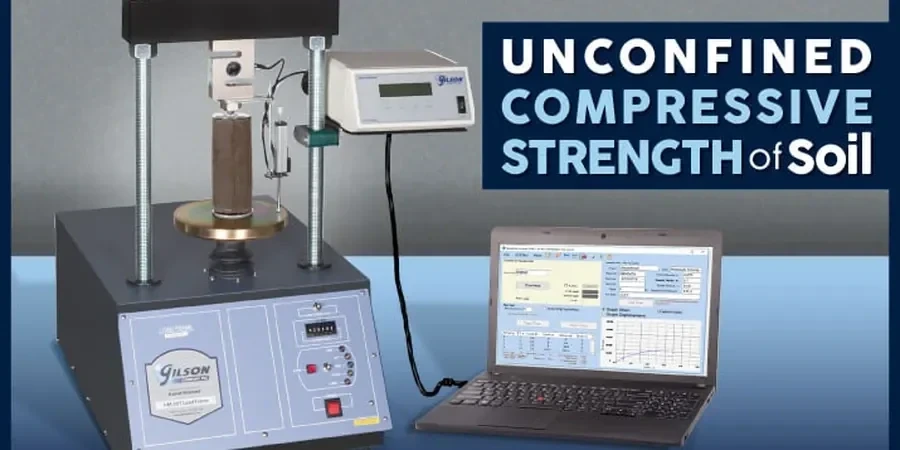
A single unconfined compression test on a glacial till sample from Birmingham can save weeks of foundation redesign by providing quick, reliable undrained strength data.
Scope of work in Birmingham
Critical ground factors in Birmingham
In Birmingham, a common oversight is assuming that the unconfined compression test results alone are sufficient for all foundation designs. The test only measures undrained strength, which is valid for short-term loading in saturated clays. For long-term drained conditions, or in partially saturated soils found on higher ground in areas like Moseley or Edgbaston, the UCS test can overestimate strength. Engineers must also consider sample disturbance — even careful tube sampling can reduce measured strength by 20-30%. Relying solely on UCS data without complementary tests like triaxial or direct shear can lead to unconservative designs, especially in the Mercia Mudstone where fissures and weathering create anisotropic behaviour. A proper ground investigation in Birmingham should always integrate UCS results with other laboratory and field data.
Our services
Our Birmingham laboratory offers a complete suite of unconfined compression testing services, tailored to the region's specific soil conditions and project requirements.
Standard UCS Testing (BS 1377-7)
Routine unconfined compression tests on undisturbed cohesive samples from Birmingham sites. Includes sample preparation, trimming, loading, and reporting of undrained shear strength with stress-strain curves. Typical turnaround is 3-5 working days.
UCS with Moisture Content & Density
Combined testing where each UCS specimen is weighed before and after the test to determine bulk density and moisture content. This data is essential for correlating strength with soil state, especially in the variable glacial tills of Birmingham.
Multi-Specimen UCS (Sensitivity Assessment)
Testing three or more identical specimens from the same sample to assess soil sensitivity (ratio of undisturbed to remoulded strength). This is particularly relevant for Birmingham's soft alluvial clays in areas like the Rea Valley.
Q&A
What is the difference between UCS and unconsolidated undrained triaxial (UU) tests?
Both measure undrained shear strength, but the UU triaxial test applies a confining pressure to the sample before shearing, while the UCS test has no confining pressure. The UCS test is simpler and faster, but it is only valid for saturated cohesive soils with zero effective confining stress at failure. For most Birmingham clays, the UCS test gives a slightly lower strength than a UU test due to the absence of confinement.
How much does an unconfined compression test cost in Birmingham?
The typical cost for a single unconfined compression test in the Birmingham area ranges from £260 to £450, depending on the number of specimens, required moisture content/density measurements, and the urgency of the turnaround. Volume discounts are available for multi-specimen projects.
Can UCS tests be performed on stiff fissured clays like Mercia Mudstone?
Yes, but with caution. Stiff fissured clays often contain discontinuities that control the failure plane. The UCS test may yield highly variable results depending on whether the failure plane aligns with a fissure. For these materials, we recommend testing multiple specimens and, if possible, performing a UU triaxial test to account for the effect of fissures. In Birmingham, many foundations on Mercia Mudstone rely on UCS data supplemented by plate load tests.
What sample quality is required for a reliable UCS test?
The sample must be undisturbed, typically obtained using a thin-walled (Shelby) tube or a piston sampler. The sample should have a diameter of at least 38 mm and a length sufficient to trim a specimen with a 2:1 height-to-diameter ratio. Any visible cracks, inclusions, or signs of disturbance (e.g., smearing, voids) will compromise the result. In Birmingham's glacial tills, it is common to encounter gravel-sized clasts that can cause local stress concentrations and premature failure.