Birmingham’s subsurface is dominated by glacial and fluvial terrace deposits, with loose granular soils extending down 10–15 m in the valley of the River Rea. These alluvial sands and gravels, often containing pockets of soft clay, present a classic densification challenge. Vibrocompaction design in Birmingham directly addresses this by rearranging loose particles into a denser state, reducing void ratios and improving relative density from around 40% to over 75%. Before mobilising vibrators, we always cross-check stratigraphy with a Cone Penetration Test to map thin layers that may affect penetration rates. The method works best when the fines content stays below 15%, which is typical for the city’s terrace gravels.
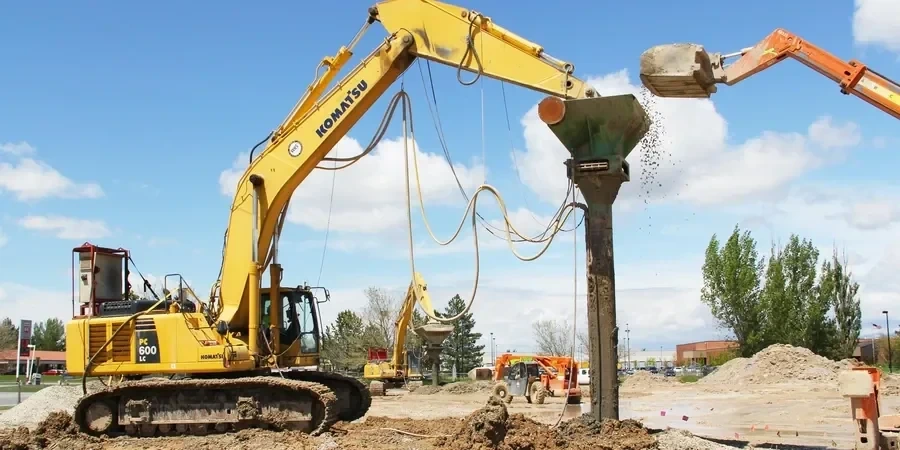
A post-treatment SPT blow count above 20 and relative density over 70% are typical targets for vibrocompaction in Birmingham’s terrace deposits.
Scope of work in Birmingham
- Relative density target (Dr > 70%) and post-treatment SPT blow count (N60 > 20).
- Vibrator type — electric or hydraulic — selected based on site access and compaction energy required.
- Spacing and pattern: triangular grid typically 2.0–3.5 m centre-to-centre, adjusted after a trial area.
- Depth of treatment: usually 8–12 m to reach competent natural strata below the made ground.
Critical ground factors in Birmingham
Birmingham expanded rapidly during the Industrial Revolution, with extensive infilling of old mining voids and canal basins with loose colliery spoil and demolition rubble. This made ground is highly variable: compaction characteristics can change within metres. If vibrocompaction design in Birmingham is not tailored to these heterogeneities, differential settlements after construction are likely. A trial area with full instrumentation is therefore mandatory. We also check for remnants of the former Birmingham Canal Navigations — unrecorded backfilled channels can stop a vibrator cold.
Our services
Our full suite of vibrocompaction services covers every phase, from feasibility assessment to post-treatment validation.
Feasibility Study & Soil Suitability
We review existing borehole logs and perform a preliminary sieve analysis to confirm fines content below 15%. A trial area is compacted to verify grid spacing and energy requirements before full-scale production.
Vibrocompaction Design & Specification
Detailed calculations of required relative density, settlement reduction, and liquefaction mitigation. We produce a compaction plan with exact probe positions, depths, and retraction rates tailored to Birmingham's ground conditions.
Field Supervision & QA/QC
Real-time monitoring of vibrator depth, amperage, and compaction time. We conduct post-treatment SPT and CPT soundings at a frequency of one test per 250 m² to confirm target N60 values are met across the site.
Validation Report & Certification
A comprehensive report summarising pre- and post-treatment testing, as-built compaction records, and certification that the ground meets the design specification and BS EN 1997-1 requirements.
Q&A
What is the typical cost range for vibrocompaction design in Birmingham?
For a medium-sized site (2,000–5,000 m²) with treatment depths of 8–12 m, the design and supervision cost typically falls between £1,070 and £3,560. This includes feasibility review, compaction planning, and post-treatment validation testing. Site-specific variables such as access constraints and the number of trial probes may affect the final quote.
How deep can vibrocompaction treat in Birmingham's terrace deposits?
In the glacial and fluvial terrace deposits found across Birmingham, effective treatment depth ranges from 8 to 12 m using standard electric vibrators. Maximum depth is limited by the vibrator's pulling capacity and the presence of dense layers below 15 m, where alternative techniques like dynamic compaction may be considered.
Does vibrocompaction work in made ground with old foundations or voids?
It depends on the size and continuity of buried obstructions. Vibrocompaction can densify loose granular fill around small obstacles, but large masonry foundations or unrecorded canal backfills may require pre-treatment removal. We always recommend a targeted trial area with pre- and post-treatment CPT to confirm treatability before full-scale works.