One mistake we see on Birmingham construction sites is assuming that all clay behaves the same way. The city sits on a deep sequence of Mercia Mudstone, overlain by glacial till and river terrace deposits along the Rea Valley, and that variability means a footing that works on one side of the street can settle twice as much fifty metres away. When builders skip a proper differential settlement analysis before pouring foundations, they often come back six months later with cracked blockwork and jammed doors. Our team uses boreholes, settlement gauges, and consolidation testing to map out exactly how much each part of the building will move relative to the next, so you can design slabs and strip footings that actually tolerate the ground beneath them.
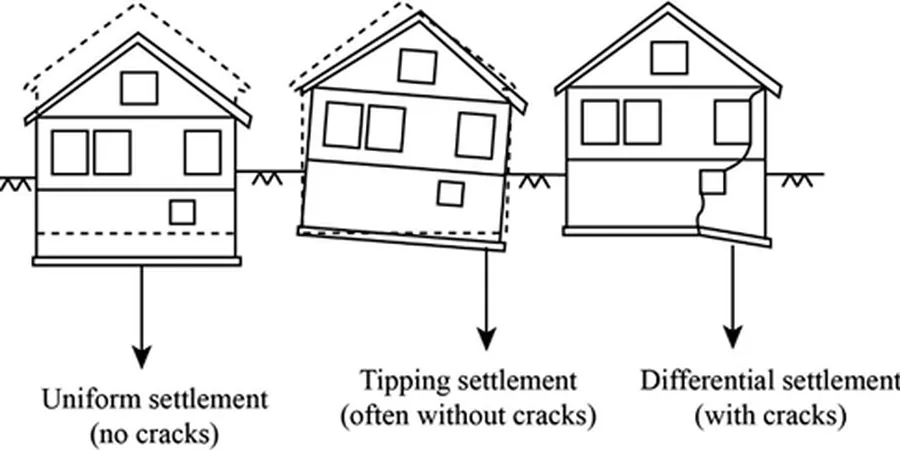
On Birmingham clay, the difference in settlement between two adjacent columns can exceed 25 mm if the drift thickness changes across the site.
Scope of work in Birmingham
Critical ground factors in Birmingham
The real danger in Birmingham is not that the ground settles – every clay does – but that it settles unevenly. We have seen a warehouse floor in Nechells crack so badly that the overhead crane rails had to be realigned after two years, simply because the boreholes were too far apart and missed a buried channel of soft silt. If you are working on a site with variable drift thickness or made ground from the city’s industrial past, a differential settlement analysis that includes continuous sampling and at least one vane shear test profile in the softest layer will catch those weak zones before they cause structural damage.
This service complements our laboratory testing work for a complete project analysis.
Our services
We offer a complete differential settlement analysis package tailored to Birmingham’s ground conditions, from initial site investigation through to long-term monitoring.
Borehole Investigation & Sampling
Rotary or window-sample boreholes drilled across the site to map clay thickness, drift variability, and any buried channels. Undisturbed samples are taken for lab consolidation tests.
Settlement Monitoring with Precision Survey
Installation of settlement plates, magnetic extensometers, or liquid-level gauges to measure actual movement during and after construction. Data logged weekly and compared against predicted values.
Numerical Modelling & Differential Movement Report
One-dimensional consolidation analysis and finite-element modelling (Plaxis 2D or Settle3) to predict differential settlement under working loads. Output includes isopach maps and angular distortion contours.
Q&A
How soon should I order a differential settlement analysis for my Birmingham project?
Ideally before the foundation design is finalised, so that the structural engineer can adjust footing sizes or specify Improvement if needed. For most residential and commercial builds in Birmingham, we recommend starting the investigation at least six to eight weeks before piling or trench filling begins.
What is the typical cost of a differential settlement analysis in Birmingham?
A standard investigation covering two boreholes, consolidation testing, and a settlement report ranges between £500 and £1.320, depending on borehole depth, number of samples, and whether monitoring equipment is installed. We provide a fixed-price quote after a brief site visit.
Can you combine the analysis with a bearing capacity check for shallow foundations?
Yes, absolutely. The same boreholes and lab tests we use for differential settlement also give us the shear strength parameters needed for bearing capacity calculations under BS 8004. We routinely include both in one integrated report.