A common mistake contractors make in Birmingham is assuming the ground is uniform across the city. The geology beneath the Bullring is not the same as the ground near Perry Barr. Deep excavations here cut through complex sequences of glacial till, terrace gravels, and the Mercia Mudstone Group. Without a site-specific geotechnical design of deep excavations, lateral wall deflections can exceed 50 mm, and base heave may compromise the entire excavation. A preliminary study of ground stability should inform the initial shoring concept. Ignoring these local variations has led to delayed projects and costly redesigns across the West Midlands.
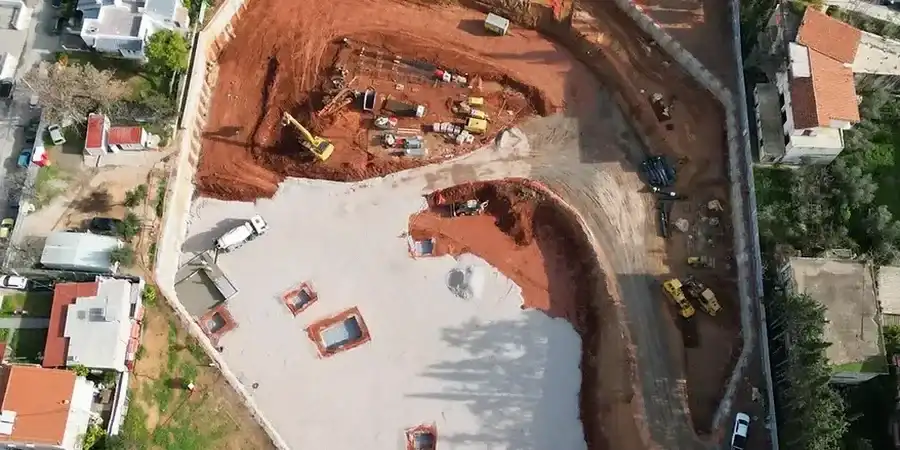
In Birmingham, the presence of glacial till over Mercia Mudstone creates a perched water table that many excavation designs overlook until it is too late.
Scope of work in Birmingham
- Peak and residual friction angles of Mercia Mudstone (typically 25° to 35°)
- Undrained shear strength of glacial till (su between 80 and 200 kPa)
- Groundwater regime, often perched above the Keuper Marl
- Stiffness modulus for serviceability checks (E' between 50 and 200 MPa)
Live process video
Critical ground factors in Birmingham
Eurocode 7 (BS EN 1997-1:2004) and the UK National Annex mandate that the design of deep excavations must account for three limit states: ultimate, serviceability, and hydraulic failure. In Birmingham, the risk of hydraulic heave is particularly high along the River Rea corridor, where artesian pressures exist beneath the clay layers. A design that omits a detailed groundwater monitoring plan can lead to sudden base failure. The cost of such an event in a dense urban area like the Jewellery Quarter runs into the hundreds of thousands. This is why every geotechnical design of deep excavations in Birmingham must include a standpipe or piezometer array.
This service complements our laboratory testing work for a complete project analysis.
Our services
Our Birmingham-based engineering team delivers two core packages for deep excavation projects, each tailored to the local ground conditions and regulatory requirements.
Basement Wall & Shoring Design
Design of contiguous piles, secant pile walls, or sheet pile walls with structural verification per BS EN 1997-1. Includes bending moment, shear, and deflection calculations for excavation depths up to 15 m in Birmingham's glacial soils and Mercia Mudstone.
Dewatering & Groundwater Control Strategy
Hydrogeological assessment for temporary works dewatering, including wellpoint design, filter compatibility, and discharge consent applications. Suitable for the perched water tables and artesian conditions found across the city.
Q&A
What is the typical cost range for a geotechnical design of deep excavations in Birmingham?
For a standard urban basement in Birmingham, the geotechnical design fee typically ranges between £1,720 and £5,810. This covers the wall analysis, groundwater modelling, and preparation of the design report. The final figure depends on excavation geometry, number of support levels, and the complexity of the ground model.
Why is the Mercia Mudstone so variable in Birmingham?
The Mercia Mudstone in Birmingham is not a uniform rock. It contains interbedded siltstone, gypsum veins, and sandstone lenses that alter its strength and stiffness. Weathering profiles also differ: the top 3–5 m is often completely weathered to a firm clay, while deeper layers are moderately strong. A good design must account for this vertical zonation.
How deep can a basement be excavated in Birmingham without temporary works?
In most Birmingham soils, any excavation deeper than 1.2 m requires temporary works or a battered slope. For basements exceeding 3.0 m, a full geotechnical design of deep excavations is mandatory under CDM Regulations 2015. The presence of groundwater typically limits unsupported depth to 2.0 m even in stiff till.
What is the difference between a secant pile wall and a sheet pile wall for Birmingham ground?
Secant piles are stiffer and provide a watertight barrier, making them ideal for inner-city basements next to existing structures. Sheet piles are more cost-effective and faster to install, but they may not seal effectively through the gravels and cobbles of the Birmingham terrace deposits. The choice depends on the allowable movement and groundwater cut-off requirements.