Working in Birmingham, we see soils that range from glacial tills over Mercia Mudstone to river terrace deposits along the Rea and Tame. The city's seismic hazard is low compared to active regions, but liquefaction risk isn't zero – especially where saturated sandy layers sit below the water table. Our lab runs SPT-based evaluations following the NCEER 2001 guidelines, correlating blow counts with cyclic resistance ratios. We also perform cyclic triaxial tests on undisturbed samples when higher confidence is needed. Before starting any analysis, we always check borehole logs for zones of loose, saturated sand – that's where the problem hides.
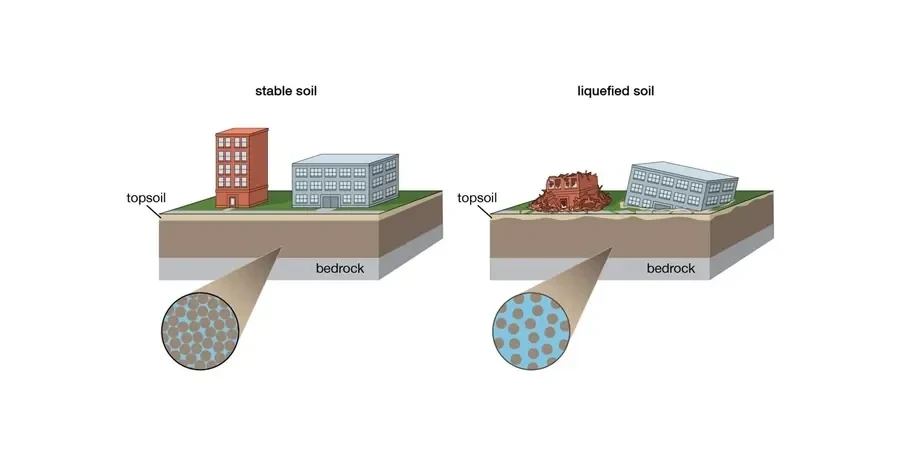
Even in low-seismicity regions like the West Midlands, loose saturated sands beneath the water table can liquefy if the right earthquake comes.
Scope of work in Birmingham
Live process video
Critical ground factors in Birmingham
Eurocode 8 Part 5 (BS EN 1998-5:2004) classifies ground types based on vs30/" data-interlink="1">shear wave velocity – but it doesn't replace a site-specific liquefaction check. In Birmingham, the main risk comes from alluvial sands along river corridors and areas where old mining backfill has been left loose. Saturated with a high water table, these layers lose strength rapidly during shaking. A factor of safety below 1.2 means we flag the zone for deeper Improvement or deeper foundations. We've seen cases where ignoring this led to differential settlements of 50 mm after a minor tremor – enough to crack masonry walls.
Our services
We offer two complementary services for liquefaction analysis in Birmingham, covering both field screening and advanced laboratory testing.
SPT-Based Liquefaction Screening
Using standard penetration test data from your boreholes, we apply the NCEER 2001 method to calculate cyclic resistance ratios, factors of safety, and settlement estimates. Corrected for fines content, overburden, and hammer energy. Report includes liquefaction potential maps for the site.
Cyclic Triaxial Testing
On undisturbed samples from Birmingham's river terrace sands, we run cyclic triaxial tests to measure pore pressure generation and axial strain under repeated loading. Results give site-specific CRR curves rather than reliance on empirical correlations. Suitable for high-risk structures.
Q&A
How much does a soil liquefaction analysis cost in Birmingham?
A typical liquefaction assessment for a residential or commercial site in Birmingham ranges from £2,090 to £3,750, depending on the number of boreholes, testing depth, and whether you need SPT-based screening or cyclic triaxial tests. The price includes all corrections, factor-of-safety calculations, and a full geotechnical report. For large infrastructure projects the cost can be higher due to additional sampling and advanced lab work.
Does Birmingham have any history of soil liquefaction?
Birmingham lies in a low-seismicity region, so no significant liquefaction events have been recorded locally. However, minor tremors from the UK's intraplate faults – like the 2002 Dudley earthquake (magnitude 4.8) – can shake loose saturated sands in the river valleys. The main concern is for post-mining areas and alluvial zones where the water table is within 3 metres of the surface.
What is the difference between SPT-based and cyclic triaxial methods?
The SPT-based method (NCEER 2001) uses blow counts and fines content to estimate cyclic resistance. It's quick, low-cost, and widely accepted for preliminary screening. Cyclic triaxial testing subjects undisturbed samples to repeated loading in the lab, measuring actual pore pressure buildup and strain. It costs more but gives site-specific CRR values, which is important for critical structures like hospitals, schools, or high-rises.
How do you handle high fines content in Birmingham soils?
We apply the fines correction factor (ΔN₁)₆₀ from the NCEER 2001 method, which adds between 0 and 8 blows to the SPT count depending on fines percentage. If the fines exceed 35% we check the plasticity index – non-plastic fines behave like sand, plastic fines like silt. For borderline cases we run cyclic triaxial tests on the actual soil rather than rely on corrections.