The geology of Birmingham is dominated by glacial till overlying mudstones of the Mercia Mudstone Group, with the water table often sitting 3 to 6 metres below ground level. These conditions demand careful pile foundation design to manage settlement risks and ensure load transfer through variable strata. Before specifying a pile type, a thorough ground investigation is essential — the study of soil mechanics reveals stratigraphy and groundwater behaviour, while test pits allow visual inspection of shallow soils. In Birmingham, where brownfield sites are common, these preliminary steps reduce uncertainty and prevent costly redesigns during construction.
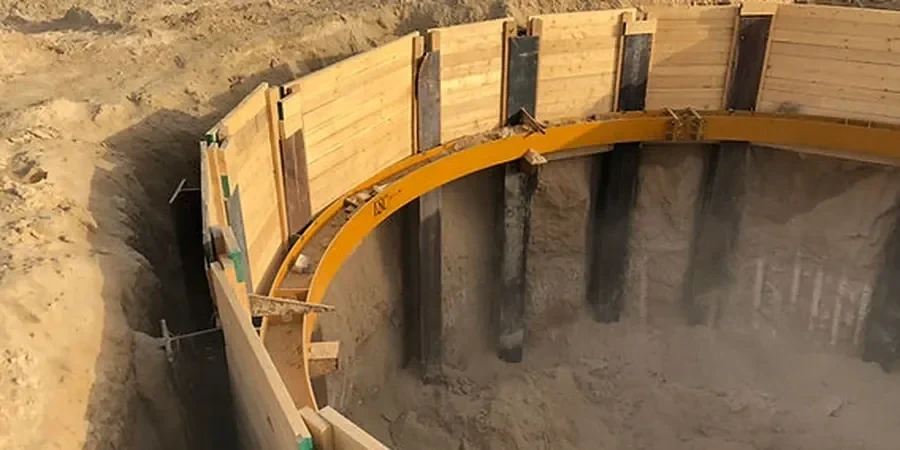
Birmingham's glacial till and Mercia Mudstone demand pile design that accounts for variable till density and potential dissolution features.
Scope of work in Birmingham
- Calculation of ultimate and serviceability limit states for vertical and lateral loads
- Selection of pile type (driven precast, CFA, or continuous flight auger) based on ground conditions and access constraints
- Verification of group effects and negative skin friction in soft alluvial deposits
Critical ground factors in Birmingham
A typical mistake in Birmingham is assuming that glacial till behaves uniformly across a site. In reality, till density varies laterally due to depositional history, and pockets of soft clay or weathered mudstone can cause differential settlement. When pile foundation design ignores these local variations, the result is often excessive tilting or load redistribution that exceeds structural tolerances. Adding a seismic check is rarely needed in this low-seismicity region, but the risk from dissolution features in the underlying gypsum-bearing Mercia Mudstone requires careful borehole coverage to avoid voids beneath pile toes.
Our services
We offer a complete range of pile foundation design services tailored to Birmingham's ground conditions. Each service integrates field data, laboratory testing, and numerical analysis to produce a compliant design package.
Driven Precast Pile Design
Design of driven precast concrete piles for sites with dense till and limited headroom. Includes driveability analysis, dynamic monitoring specifications, and static load test interpretation per BS EN 1997-1.
Continuous Flight Auger (CFA) Pile Design
CFA pile design for cohesive and granular soils in Birmingham, with emphasis on skin friction profiles extracted from SPT and CPT data. We verify concrete volume and reinforcement details to meet Eurocode 2.
Pile Group and Settlement Analysis
Three-dimensional group analysis for closely spaced piles, accounting for interaction effects in the Mercia Mudstone. We provide settlement contours and differential movement predictions under working loads.
Q&A
What is the typical cost range for a pile foundation design in Birmingham?
The typical cost for a full pile foundation design package in Birmingham ranges from £1.370 to £5.160, depending on site size, number of pile types considered, and the level of numerical modelling required. This covers site data review, calculation notes, reinforcement schedules, and a design report.
How long does a pile foundation design take for a Birmingham project?
A standard design for a medium-sized residential or commercial project in Birmingham takes 2 to 4 weeks, assuming ground investigation data is available. Complex sites with variable till or potential dissolution features may require an additional week for sensitivity analysis.
Do I need a separate structural engineer for the pile cap?
No, our pile foundation design includes the pile cap layout and reinforcement detailing to BS EN 1992-1-1, ensuring that the cap properly distributes column loads to the pile group. We coordinate with your structural engineer for superstructure loads.