Rigid pavement design in Birmingham follows the principles of BS EN 1997 and the UK Design Manual for Roads and Bridges. The city's underlying Mercia Mudstone and River Terrace deposits create variable subgrade conditions. A CBR value below 3% is common in areas like Saltley and Small Heath, requiring thicker slabs or a cement-treated sub-base. We always begin with a site investigation to map the bearing capacity and moisture regime. For deeper understanding of the subgrade we often run an ensayo CBR on undisturbed samples. The concrete specification typically targets C32/40 with a flexural strength of 4.5 MPa. Joint spacing is calculated from the slab thickness and the thermal gradient expected in Birmingham's temperate climate.
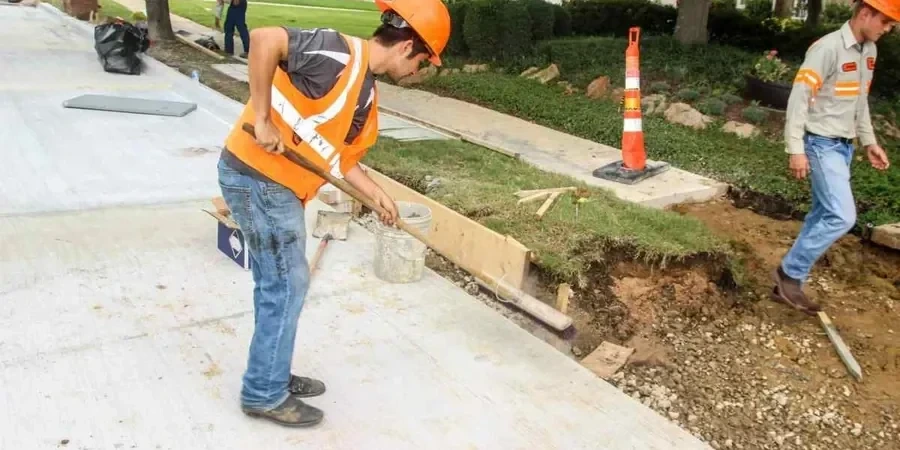
A CBR below 3% in Birmingham's river terraces demands a 280 mm slab and a 200 mm cement-treated layer to avoid fatigue cracking.
Scope of work in Birmingham
Critical ground factors in Birmingham
We worked on a depot extension near Bordesley. The contractor had already poured a 200 mm slab before we tested the subgrade. The CBR came back at 1.8 %. Within six months the slab had cracked across three joints. The fix required breaking out the concrete, adding a 250 mm cement-bound layer, and re-pouring with dowels. That cost the project an extra three weeks and significant money. A proper rigid pavement design must start with the ground data. Ignoring the Mercia Mudstone's tendency to soften when wet is a mistake we see too often in Birmingham.
Our services
Our laboratory in Birmingham offers two dedicated services for rigid pavement design, covering both the ground investigation and the concrete specification.
Subgrade investigation and CBR testing
We carry out dynamic and laboratory CBR tests on samples from boreholes and trial pits. The results are used to classify the subgrade strength and to calculate the required slab thickness according to DMRB CD 225. For low-strength ground we also recommend a cement-treated sub-base.
Concrete mix design and flexural strength verification
We design concrete mixes to meet the specified flexural strength and workability. The target is typically 4.5 MPa at 28 days for C32/40. We also verify the modulus of rupture on beam specimens and check the freeze-thaw resistance for Birmingham's exposure class XF1.
Q&A
What CBR value is considered poor for rigid pavement design in Birmingham?
A CBR below 3 % is poor. In parts of Birmingham with river terrace deposits the CBR can fall to 1.5 – 2.5 %. For these cases we recommend a minimum slab thickness of 280 mm and a 200 mm cement-treated sub-base.
What is the typical concrete grade used for rigid pavements in Birmingham?
For most urban roads and industrial yards we specify C32/40 with a flexural strength of 4.5 MPa. For heavy-duty bus routes or HGV access roads we use C40/50 with a 250 mm slab and steel dowels at joints.
How much does a rigid pavement design study cost in Birmingham?
The cost ranges between £1.330 and £5.710 depending on the number of boreholes, CBR tests, and concrete mix designs required. A typical single-road design with two test pits and five CBR tests falls around £2.400.
Which UK standard governs rigid pavement design?
The main standards are BS EN 1997-1 for geotechnical design, BS EN 1992-1-1 for concrete design, and the DMRB CD 225 for pavement thickness calculation. The UK National Annex to Eurocode 2 also applies.