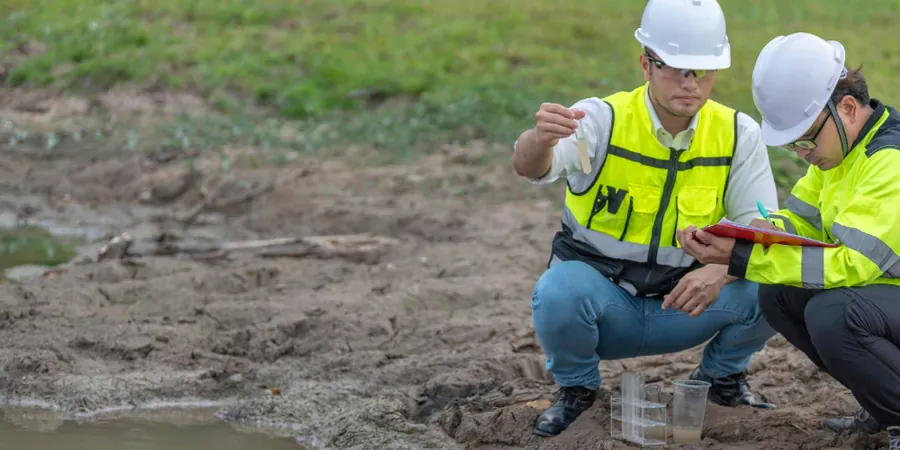
Our team deploys a tracked Terrier rig across Birmingham's varied sites to extract continuous core samples from residual soils. These soils, weathered directly from the underlying Mercia Mudstone and Keuper Marl, demand careful handling. We use triple-tube samplers to preserve the delicate fabric and measure recovery ratios on site. The city's complex geology, shaped by Triassic depositions and subsequent uplift, means each borehole tells a different story. Before any laboratory work begins, we log every metre against BS 5930:2015 to ensure consistent description. This fieldwork forms the backbone of reliable characterization, giving engineers the raw data they need to assess bearing capacity and settlement potential.
Residual soils in Birmingham exhibit a sharp decrease in strength below the weathered crust, demanding depth-dependent characterization for any foundation design.
Scope of work in Birmingham
Critical ground factors in Birmingham
Birmingham's rapid 19th-century industrial expansion pushed construction onto marginal ground, including deep residual soil profiles on hillsides. These soils often contain relict joints and slickensides from past mass movements. When loaded unevenly, they can undergo differential settlement or sudden shear failure. The risk is compounded by the seasonal moisture cycle: winter saturation reduces suction and effective stress, while summer desiccation causes shrinkage and cracking. We have seen cases where a shallow foundation on residual clay settled 30 mm in two years because the weathering profile was not properly logged. Our characterization explicitly maps these discontinuities and quantifies the collapse potential under wetting, giving designers the data needed to avoid costly remediation.
Our services
We offer targeted services to address the specific challenges of residual soils in Birmingham:
Weathering Profile Assessment
Detailed logging of weathering grades from VI to IV, including mineralogical analysis and field suction measurements. We correlate the profile with SPT N-values and shear strength to define design layers for shallow and deep foundations.
Collapse Potential and Swell Testing
Oedometer tests at natural moisture content and after wetting to quantify collapse strain. We also measure swell pressure on expansive residual clays, providing parameters for foundation design in areas like Perry Barr and Moseley.
Q&A
What is the difference between residual soil and transported soil in Birmingham?
Residual soil forms in place from chemical weathering of the underlying Mercia Mudstone or Keuper Marl, preserving relict rock structure. Transported soil, like glacial till found in the Birmingham area, has been moved by ice or water and has no consistent relationship with the bedrock. This distinction is critical for foundation design because residual soils often have higher variability in strength and stiffness with depth.
What tests are essential for residual soil characterization?
We recommend a minimum suite of natural moisture content, Atterberg limits, particle size distribution, and undrained triaxial strength on undisturbed samples. For sites with suspected collapse or shrink-swell behaviour, we add oedometer tests with controlled wetting and cyclic suction measurements. X-ray diffraction helps identify clay mineralogy when plasticity indices are high.
How much does residual soil characterization cost in Birmingham?
A typical investigation for a residential plot ranges between £740 and £2.490, depending on the number of boreholes, sample recovery method, and laboratory testing scope. Complex sites with deep weathering profiles or multiple trial pits may fall at the higher end. We provide a fixed-price quotation after a site walkover.
Why is residual soil characterization important for Birmingham's brownfield sites?
Many brownfield sites in Digbeth and the Jewellery Quarter have residual soils overlain by made ground. Without proper characterization, engineers may underestimate settlement from the soft residual layer beneath the fill. We have seen cases where differential movement between the two layers caused cracking in new-build flats. Our profile mapping prevents this by defining the interface and measuring compressibility of each stratum.