Birmingham sits on a mix of glacial till, river terrace deposits, and Mercia Mudstone bedrock. The water table varies from 2 m to over 8 m depending on the district. For seismic foundation design, we need reliable Vs30 profiles and shear-wave velocity data. The local ground can amplify motion in soft zones near the River Tame. That is why we always run a MASW survey first to map stiffness changes with depth. Without that baseline, designing for earthquake loads becomes guesswork. Our team has processed over 200 sites in the West Midlands and knows exactly where the soil profile shifts.
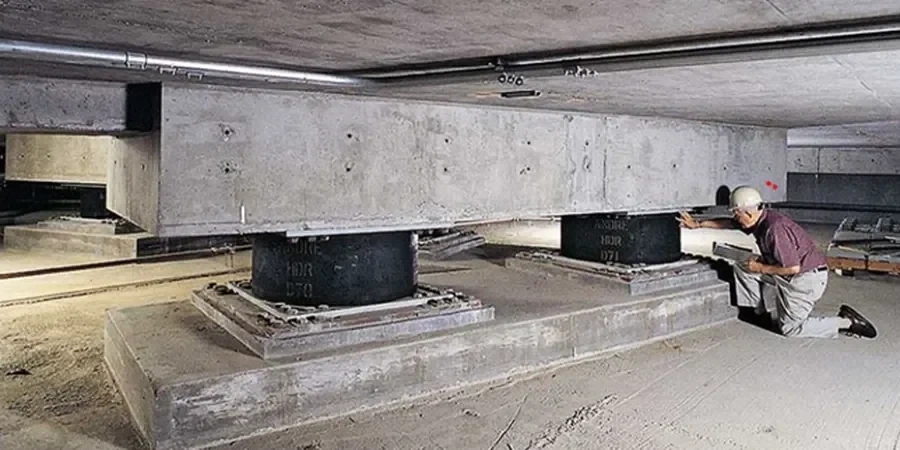
Birmingham's variable glacial till and river deposits demand site-specific Vs30 data – not a generic map – to avoid under-designing against seismic loads.
Scope of work in Birmingham
- Site classification per Eurocode 8 (ground types A to E)
- Peak ground acceleration (PGA) at rockhead
- Liquefaction potential index (LPI) using NCEER method
Critical ground factors in Birmingham
Birmingham expanded rapidly during the Industrial Revolution, with many canals and railway cuttings cut through soft ground. Today, infill development on former industrial land is common, and those man-made deposits can liquefy under moderate shaking. The 2002 Dudley earthquake (magnitude 4.8) caused minor damage but reminded engineers that the region is not aseismic. For seismic foundation design, the real risk is differential settlement between natural till and backfilled zones. We always check the fill thickness and compaction level before finalising the foundation layout.
Our services
Our Birmingham lab delivers two core services that support seismic foundation design directly. Each is tailored to the local geology and project scale.
Shear-Wave Velocity Profiling (MASW & ReMi)
We deploy multichannel analysis of surface waves to generate 2D Vs profiles down to 30 m. The data classifies the site per EC8 and provides the stiffness input for dynamic foundation analysis.
Cyclic Triaxial & Resonant Column Testing
We measure shear modulus degradation and damping ratio under cyclic loads. These parameters are essential for equivalent-linear site response analysis in Birmingham's variable ground.
Q&A
How much does seismic foundation design typically cost in Birmingham?
For a standard residential or commercial project, the geotechnical investigation and design package ranges between £1,060 and £3,290. The final figure depends on the number of boreholes, depth of profiling, and complexity of the soil profile.
What site class is most common in Birmingham under Eurocode 8?
Most of central Birmingham falls into ground type B (dense sand or stiff clay) or type C (medium-dense sand or firm clay). Areas along the River Tame valley can shift to type D (loose granular or soft cohesive soil), which requires a site-specific response analysis.
Do I need a liquefaction assessment for a Birmingham site?
Yes, if the site has saturated loose sands or silty fills within the top 15 m. We evaluate using the NCEER SPT-based method and Youd-Idriss 2001 criteria. For shallow fills near canals, the liquefaction factor of safety can drop below 1.0 under the UK design earthquake.