A triaxial test rig sits in a Birmingham laboratory, its hydraulic piston ready to apply confining pressure to a cylindrical soil sample. The specimen, wrapped in a rubber membrane, sits inside a clear acrylic cell filled with de-aired water. For projects across the city, from the red sandstone of the市中心 to the glacial till beneath residential estates, this test measures how soil fails under controlled stress. The equipment records axial load and pore pressure changes. It delivers the cohesion and friction angle needed for foundation design. Before any retaining wall or embankment is built, the corte directo test offers an alternative for drained conditions, but the triaxial test provides more complete data on undrained strength for Birmingham's clays.
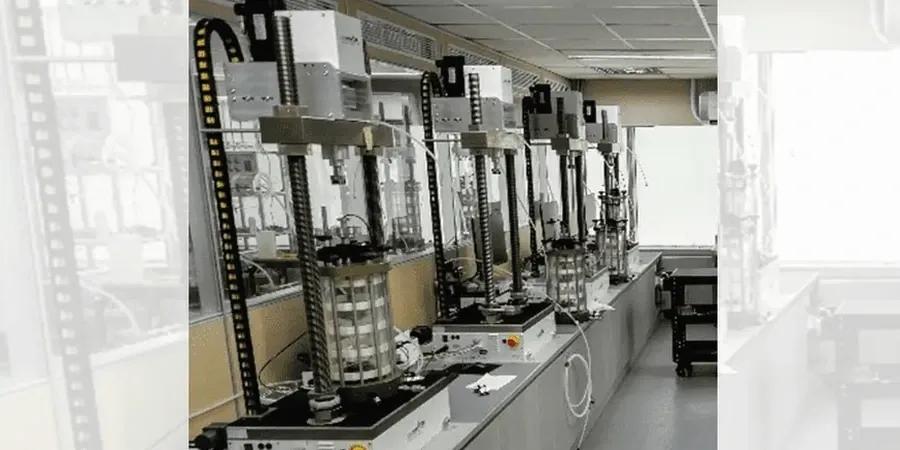
The triaxial test reveals how Birmingham's Keuper Marl behaves under load — essential data for designing foundations that won't settle unevenly.
Scope of work in Birmingham
Critical ground factors in Birmingham
Compare two sites in Birmingham: a new building in the Jewellery Quarter versus a development in Kingstanding. The Jewellery Quarter sits on made ground over weathered sandstone. The triaxial test here shows high friction angles but risk of collapse if confining stress drops. In Kingstanding, glacial till with cobbles gives variable results. A single test may miss a weak layer. That is the real risk. If the triaxial test is not run on representative samples, the design shear strength could be overestimated. Foundations then settle or shear. We always test multiple specimens at different confining stresses. This captures the natural variability in Birmingham's ground.
Our services
We provide two triaxial testing services tailored to Birmingham's geology. Each includes full reporting with Mohr circles and design parameters.
Consolidated Undrained (CU) Triaxial Test
The standard method for Birmingham clays. Saturation, consolidation under back pressure, then shearing at controlled rate. Pore pressure measured throughout. Results: effective cohesion and friction angle. Ideal for embankment stability and retaining wall design.
Unconsolidated Undrained (UU) Triaxial Test
Rapid test for undrained shear strength. No consolidation stage. Suitable for short-term stability checks on clay fills or natural slopes. Results in 24 hours. Often used alongside field vane tests for quick assessment.
Q&A
What is the difference between CU and UU triaxial tests?
The CU test includes a consolidation stage where the sample is allowed to drain under confining pressure before shearing. It provides effective stress parameters (c', phi'). The UU test skips consolidation and gives undrained shear strength (Su). For Birmingham's overconsolidated clays, CU tests are preferred for long-term design; UU tests suit temporary works.
How many triaxial tests are needed for a typical Birmingham site?
For a small residential development, three to six tests at different confining pressures are typical. For larger commercial sites, we recommend testing at least three specimens per soil stratum. The number depends on the variability of the ground. In Birmingham's Keuper Marl, changes can occur within 2 metres, so more tests may be needed.
Can the triaxial test be done on disturbed samples?
No. The triaxial test requires undisturbed samples collected with thin-walled tubes or rotary coring. Disturbed samples change the soil fabric and give unreliable strength parameters. For Birmingham sites, we use 100 mm diameter U100 tubes or 100 mm core barrels to retrieve intact specimens. The sample quality is checked before testing.
How much does a triaxial test cost in Birmingham?
The typical cost for a CU triaxial test with pore pressure measurement ranges from £1,580 to £2,180 per sample. This includes preparation, saturation, consolidation, shearing, and a full report with Mohr circles. Volume discounts apply for multiple specimens from the same site. Contact us for a quote based on your project scope.