We mobilise a 20-tonne drop weight on a crawler crane for dynamic compaction design in Birmingham. The tamper is lifted 20 m and released in a grid pattern. Each impact delivers 400 tonne-metres of energy. The process densifies loose granular fills and made ground typical of the city's former industrial zones. Before the treatment we run a georadar survey to map buried obstructions and variable fill depth. That data sets the drop pattern and energy level per pass.
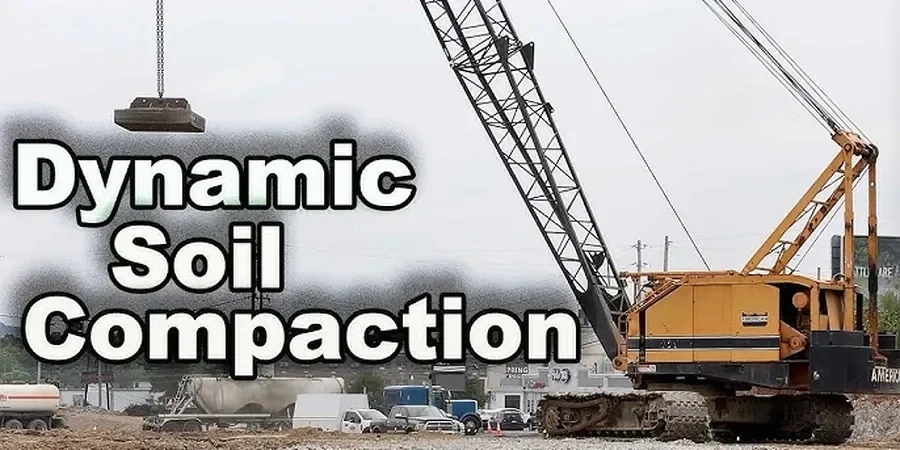
A single impact delivers 400 tonne-metres of energy. The drop pattern is set by fill thickness and target density. Verification comes from plate load tests after each pass.
Scope of work in Birmingham
Critical ground factors in Birmingham
Birmingham expanded rapidly in the 19th century. Former canals, railway sidings, and foundries left deep, variable fills. Without proper dynamic compaction design these zones settle unevenly. The risk is differential movement under new buildings. We map the fill depth and type, then tailor the energy sequence to each sector. Post-treatment plate load tests confirm the achieved modulus. That data goes into the foundation design.
Our services
We offer two complementary services that support dynamic compaction design in Birmingham.
Pre-treatment Ground Investigation
Boreholes, test pits, and georadar to map fill thickness, type, and obstructions. We classify the soil per BS 5930 and run Proctor compaction tests to set target densities.
Post-treatment Verification Testing
Plate load tests and dynamic cone penetrometer checks after each compaction pass. Results are compared to the design curve. A final report confirms the achieved bearing capacity.
Q&A
How does dynamic compaction design suit Birmingham's made ground?
The city has deep, heterogeneous fills from its industrial past. Dynamic compaction densifies granular fills up to 8 m deep. The design adapts the drop pattern and energy level to the fill type and thickness in each sector.
What is the typical cost range for dynamic compaction design in Birmingham?
The cost for design, mobilisation, and treatment is between £850 and £3,680. The range depends on site area, fill depth, and number of passes. A pre-treatment survey helps define the scope.
Can dynamic compaction be used near existing structures?
Yes, with reduced drop height and energy. We monitor vibrations with seismographs. The design keeps peak particle velocity below the thresholds in BS 5228-2. A buffer zone is calculated for each building.
What tests verify the effectiveness of the compaction?
Plate load tests measure the achieved modulus of subgrade reaction. Dynamic cone penetrometer checks show the density profile with depth. We compare both to the target values set in the design phase.