Birmingham grew fast during the Industrial Revolution. The canals and railways carved through glacial till and river terrace deposits. Our team has tested many sites across the city, from the sandstone ridges of Sutton Coldfield to the softer clays in the Tame Valley. Before any geogrid specification is written, we dig into the ground conditions. A test pit investigation reveals the actual soil profile. You cannot guess the bearing layer. We have seen specs fail because nobody checked for old backfilled pits or buried foundations. Birmingham's industrial legacy means the ground is rarely uniform. We always start with a proper site walkover and a few trial pits before committing to a reinforcement layout.
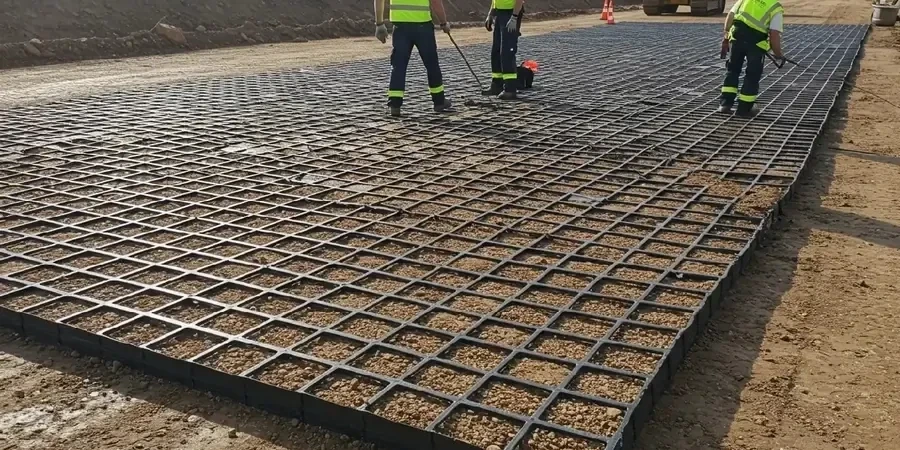
A geogrid spec without site-specific soil data is just a guess. We always verify the subgrade before selecting the grid class.
Scope of work in Birmingham
Critical ground factors in Birmingham
Compare the red sandstone of Harborne with the soft alluvium of Nechells. The difference is night and day. In the sandstone areas, a light geogrid is often enough for base reinforcement. But down by the River Rea, you face silty clays that can compress 50 mm under a road embankment. A grid with low junction strength will just open up and let the aggregate punch through. That leads to rutting and cracking within two years. We have seen developers skip the site investigation to save money. They end up replacing the whole pavement section. The cost of a proper geogrid specification is tiny compared to a failed road.
Our services
We offer four core services around geogrid specification. Each one is tailored to the ground conditions we find in Birmingham.
Tensile strength verification
We test geogrid samples in our lab to confirm the manufacturer's claimed tensile values. This includes both machine and cross-machine directions at 2% and 5% strain.
Junction efficiency analysis
We measure the force required to pull the ribs apart at the junction. A low value means the grid will not transfer load effectively in service.
Creep and durability assessment
We run accelerated creep tests at elevated temperature and extrapolate to 120 years. This tells us if the grid will hold under long-term dead load.
Installation damage trial
We bury geogrid samples under the specified aggregate and compact with site equipment. Then we exhume them and retest the tensile strength. The reduction factor is calculated directly.
Q&A
What tensile strength do I need for a geogrid in a Birmingham road base?
It depends on the subgrade CBR and traffic loading. For a CBR of 3% with light traffic, a biaxial grid with 30 kN/m ultimate strength is typical. For heavy haul roads or CBR below 2%, we specify 50 kN/m or higher. We always run a plate load test first to confirm the actual bearing capacity.
How much does a geogrid specification service cost in Birmingham?
The cost ranges between £380 and £940, depending on the number of samples tested and the complexity of the creep or damage trials. A basic tensile verification with junction efficiency is at the lower end. A full durability package with installation damage trial is at the higher end. We provide a fixed quote after reviewing the project scope.
Do I need a site investigation before specifying a geogrid?
Yes, absolutely. The subgrade stiffness and variability drive the grid class. Without a site investigation, you risk either overspending on a heavy grid or underspecifying and getting pavement failure. In Birmingham, old made ground and clay pockets make the ground highly variable. We always recommend trial pits or boreholes before writing the specification.