Birmingham sits on a complex mix of Mercian Mudstone, glacial till, and river terrace deposits, so the stability of any slope here depends heavily on local groundwater conditions and clay mineralogy. We routinely see failures along the A38 corridor where historical cutting through Keuper Marl has created long-term movement, particularly after wet winters. A thorough slope failure analysis in Birmingham starts with mapping the failure geometry and sampling the clay fabric for residual shear strength. Before we run limit equilibrium models, we always verify the drainage regime — perched water tables are common in the till layers above the sandstone. This is why we integrate on-site permeability testing to measure flow rates directly, and cross-check with instrumentation for real-time pore pressure monitoring. Without those two inputs, your factor of safety is just a guess.
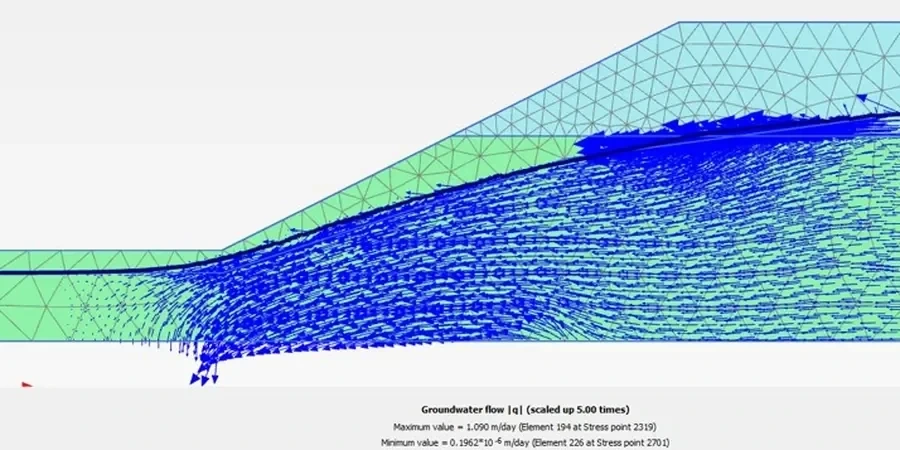
A 1 m rise in the phreatic surface can drop the factor of safety by 0.3 in Birmingham's glacial clays — field permeability is non-negotiable.
Scope of work in Birmingham
- Peak and residual friction angles from ring-shear tests on clay seams
- Bulk unit weight and moisture content — often higher than assumed in the Mercian Mudstone
- Stiffness parameters from triaxial testing with local strain measurement
Critical ground factors in Birmingham
In Birmingham, the most underestimated risk is the progressive loss of suction in the unsaturated zone above the water table. During extended dry periods, the clay crust develops apparent cohesion that vanishes after a few weeks of rain. We have documented cases in the Jewellery Quarter where a 4 m high cut stood stable for two years and then failed overnight following a 48-hour storm. Another recurring issue is the presence of relict shear surfaces from periglacial solifluction — these are invisible in borehole logs unless you core continuously. A proper slope failure analysis in Birmingham must account for these inherited weaknesses, or the remediation design will be under-designed from day one.
Our services
We offer three complementary services for slope failure analysis in Birmingham, each tailored to the site's geology and project stage.
Limit Equilibrium Analysis (Morgenstern-Price / Spencer)
Multi-wedge and circular slip surface models using peak and residual strengths, with sensitivity to groundwater and surcharge. Output includes FoS contours for each slip surface identified.
Finite-Element Slope Stability (Shear Strength Reduction)
2D and 3D FE models that capture strain localisation and progressive failure. We calibrate stiffness parameters against field instrumentation data from inclinometers and piezometers.
Back-Analysis of Existing Failures
Using measured geometry and failure surfaces to back-calculate mobilised shear strength. Essential for litigation support or designing remedial works for failed slopes in Birmingham's road network.
Q&A
How quickly can you complete a slope failure analysis for a site in Birmingham?
Typically 10–15 working days from receiving the site investigation data and boundary conditions. If we need to conduct our own field permeability tests or install piezometers, add 5–7 days for mobilisation and monitoring.
What is the typical cost range for a slope stability study in Birmingham?
Between £620 and £2,170 depending on the number of sections, whether we run laboratory ring-shear tests, and whether finite-element modelling is required. We provide a fixed-price quote after a brief site review.
Which soil parameters are most critical for Birmingham's Mercian Mudstone slopes?
Residual friction angle and the sensitivity of the phreatic surface. The mudstone's intact strength is often high, but relict discontinuities and clay seams control the failure mechanism. We always measure the residual angle directly via ring-shear testing.
Do you provide monitoring recommendations along with the analysis?
Yes. We specify inclinometer locations, piezometer depths, and trigger levels for movement alarms. For active slopes, we recommend at least two inclinometers per section and vibrating-wire piezometers in the clay layers.