In Birmingham, the legacy of glacial till overlying Mercia Mudstone creates a unique challenge for Improvement. We often see clay layers with high plasticity and low permeability that require accelerated consolidation before embankment construction or foundation works. A properly designed prefabricated vertical drain system reduces the drainage path length dramatically, turning years of natural settlement into months. For sites near the River Rea or along the M6 corridor, we combine laboratory consolidation tests with field data to tune the PVD spacing and depth. Before specifying the drain pattern, we also run a densidad-cono-arena check on the upper crust to confirm compaction isn't masking deeper issues.
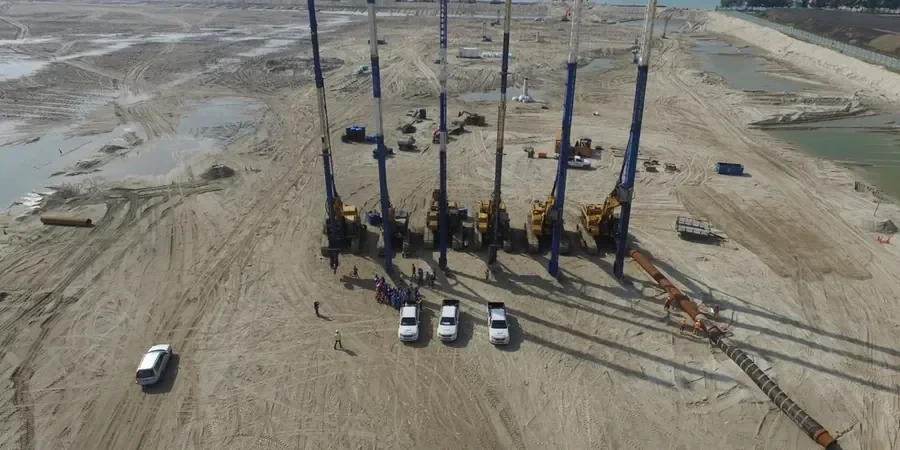
A correctly designed PVD array in Birmingham's glacial till can cut primary consolidation time by 80%, turning a 5-year wait into a 10-month programme.
Scope of work in Birmingham
Live process video
Critical ground factors in Birmingham
Birmingham's annual rainfall averages 660 mm, but the real risk lies in the seasonal groundwater fluctuation. The water table in the glacial till can rise by 2 m after a wet winter, reducing effective stress and slowing PVD performance if the surcharge is already in place. On sites like the former Longbridge works, where made ground overlies soft clay, we've seen clogging of drain filters when fine silt migrates into the core. A pre-installation granulometria test on the soil matrix helps us select the right filter geotextile and avoid premature failure.
Our services
We offer a full suite of PVD services for Birmingham projects, from feasibility studies through to on-site supervision of installation and monitoring.
PVD Feasibility Study
Review of existing borehole logs and consolidation test data to determine whether PVDs are cost-effective compared to other Improvement methods like vibro stone columns.
Detailed PVD Design & Surcharge Optimisation
Finite-element modelling of the drain array, surcharge height, and staged loading schedule. We produce settlement-time curves and pore pressure dissipation charts for each lift.
Installation Specification & Tender Support
Technical specifications covering drain type, mandrel size, installation rate, and QA/QC requirements. We help clients evaluate contractor method statements against Birmingham's ground conditions.
Performance Monitoring & Validation
Deploying piezometers, settlement plates, and inclinometers during the surcharge period. We compare real-time data against the design predictions and adjust the programme if rates deviate.
Q&A
What soil conditions in Birmingham are most suitable for PVDs?
PVDs work best in saturated fine-grained soils with a coefficient of consolidation below 5 m²/year. In Birmingham, the glacial till and alluvial clays along the River Tame and River Rea are ideal candidates. We also assess the presence of sand or silt partings, which can significantly accelerate drainage if the drains intersect them.
How does the PVD design account for the Mercia Mudstone bedrock?
The design ensures drains terminate 0.5–1.0 m above the bedrock surface to avoid disturbing the mudstone's natural drainage regime. The mudstone itself has low permeability, so the drains rely on the overlying clay's pore pressure gradient. We use the depth to bedrock from borehole records to set the drain length and avoid unnecessary tool wear.
What is the typical cost range for a PVD design and installation package in Birmingham?
For a medium-sized site (1–3 hectares) with typical glacial till, the combined design and installation cost ranges between £710 and £1,880 per drain line including mobilisation. The final figure depends on drain spacing, total depth, and the need for surcharge material. We always provide a bespoke quotation after reviewing the ground investigation data.