Birmingham's ground conditions shift dramatically between the sandstone ridge of the Jewellery Quarter and the deep glacial till of the Perry Barr corridor. In the city centre, the Mercia Mudstone Group can sit within a few metres of the surface, while towards Kingstanding you can encounter up to 18 metres of clay-rich till overlying bedrock. These abrupt lateral changes in stiffness control how seismic waves propagate. A site in Digbeth underlain by soft alluvium may amplify ground motion by a factor of two or more compared to a site on competent sandstone just half a mile away. That is why we always run a MASW-VS30 profile before modelling the dynamic response — you need the shear-wave velocity layering to even begin estimating the site factor correctly.
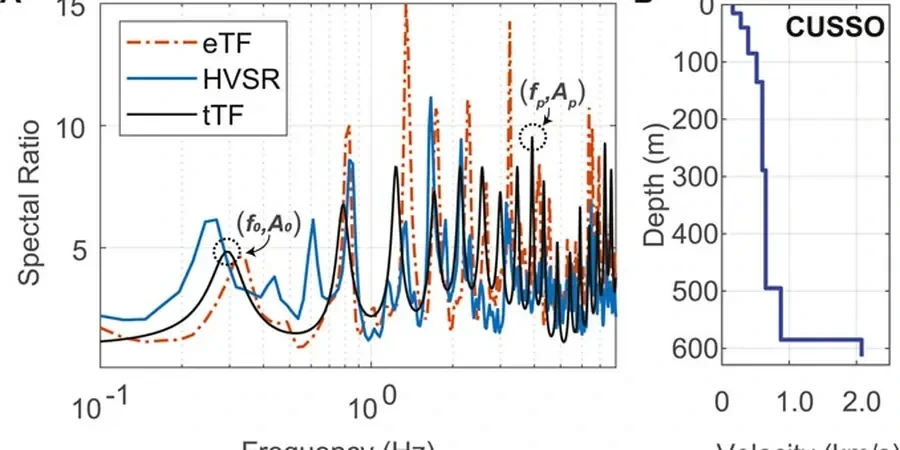
A site on soft alluvium in Digbeth can amplify ground motion by a factor of two compared to sandstone bedrock just half a mile away — VS30 profiling is non-negotiable.
Scope of work in Birmingham
- VS30 profile (m/s) for site classification per EC8
- Fundamental frequency f0 (Hz) from H/V spectral ratio
- Amplification factor A(f) across the 0.5–10 Hz band
- Soil column stratigraphy to 30–50 m depth
Live process video
Critical ground factors in Birmingham
The Triassic sandstone that underlies most of central Birmingham is generally stiff and non-liquefiable, but the real hazard sits in the river valleys. In Sparkbrook and along the River Cole, soft alluvial silts and organics can exceed 8 m in thickness. These deposits exhibit low shear-wave velocity and high water content, which together produce strong amplification in the 2–4 Hz band — exactly the range that can couple with medium-rise masonry buildings common across the inner ring. The 2008 Market Rasen earthquake (5.2 Mw) was felt across Birmingham, and anecdotal reports of stronger shaking in the Bordesley area correlate with the soft-ground signature we now see in VS30 maps. Ignoring site-specific amplification analysis here means you are designing blind.
Our services
We deliver the full seismic amplification workflow — from field acquisition to final design spectra — tailored to Birmingham's geology.
MASW & VS30 Profiling
Multichannel surface-wave surveys with 24–48 geophone arrays to derive 1D shear-wave velocity profiles down to 50 m depth. Output includes VS30, site class per EC8, and dispersion curves.
Microtremor HVSR (H/V Spectral Ratio)
Single-station ambient-noise recordings to identify the fundamental resonance frequency of the soil column. Essential for assessing soil-structure coupling in Birmingham's soft-ground corridors.
Downhole Seismic Logging
Direct measurement of P- and S-wave velocities in boreholes using a three-component geophone probe. Provides a benchmark layer-by-layer velocity model to validate surface-wave inversions.
Response Spectrum & Site Factor Analysis
Convolution of the design bedrock spectrum (EC8 Type 1 or 2) with the site-specific transfer function derived from the soil profile. Delivers acceleration response spectra for elastic and inelastic design.
Q&A
How much does a seismic amplification analysis cost in Birmingham?
A standard MASW-based analysis with VS30 profiling and a site factor report runs between £890 and £1,570 depending on array length, number of profiles, and whether a downhole seismic log is required. Larger sites or multiple profiles increase the cost proportionally.
Which areas of Birmingham have the highest seismic amplification risk?
The highest amplification potential is found along the River Rea corridor (Digbeth, Highgate, Balsall Heath) and the River Cole valley (Sparkbrook, Yardley Wood), where soft alluvial deposits exceed 6 m thickness. Sites on the Birmingham Fault line near the city centre may also show elevated resonance due to abrupt stiffness contrasts.
Do I need a seismic amplification study for a low-rise building in Birmingham?
Yes — even a two-storey structure on soft ground can experience significant dynamic amplification if its natural frequency (typically 4–8 Hz for low-rise masonry) aligns with the soil's fundamental frequency. Eurocode 8 requires site-specific analysis for ground types C, D, and E regardless of building height. We have seen cases in the Jewellery Quarter where ignoring this led to excessive inter-storey drift predictions during peer review.