Birmingham sits on a varied geology that includes Triassic sandstones, glacial till, and river terrace deposits along the River Rea and Tame. The city's 1.1 million residents live across a landscape where the higher ground of the Birmingham Plateau meets lower-lying areas prone to groundwater fluctuations. For any project involving a change in ground level, retaining wall design in Birmingham must account for these mixed strata and the potential for perched water tables. Our approach starts with a thorough site investigation to classify the soil, measure shear strength parameters, and establish groundwater conditions before any wall geometry or reinforcement is specified.
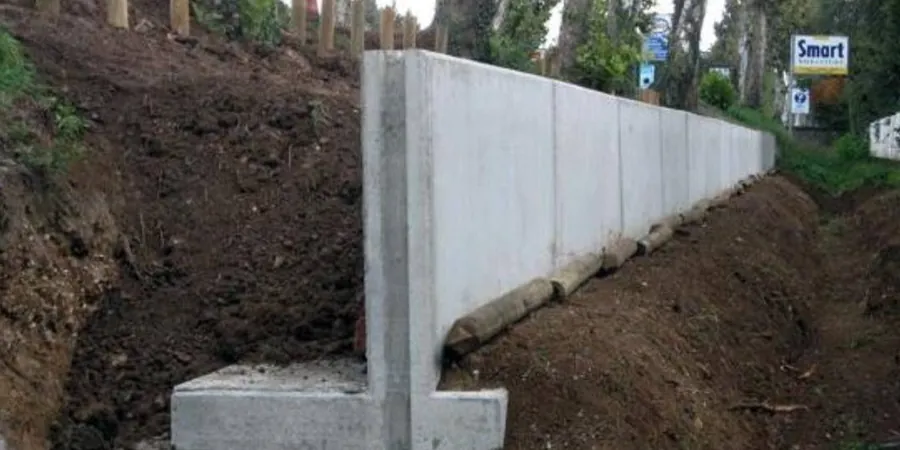
Birmingham's mixed geology demands wall designs that consider both drained and undrained strength parameters, often within the same site.
Scope of work in Birmingham
Key aspects we evaluate include:
- Active and passive earth pressures using Rankine or Coulomb theory
- Global stability against sliding, overturning, and bearing failure
- Internal stability if using reinforced soil or embedded walls
- Seepage and drainage provisions to prevent hydrostatic build-up
Critical ground factors in Birmingham
Birmingham expanded rapidly during the Industrial Revolution, with many canals, railways, and factories built on variable ground. Infilled valleys, made ground from industrial waste, and old mining workings create hidden weak zones that can compromise a retaining wall if not identified early. A wall that looks stable on paper may fail weeks after construction if perched water saturates the backfill or if the foundation soil softens. Our retaining wall design in Birmingham always includes a sensitivity check for these historical disturbances, and we recommend a [MASW survey](/masw-vs30/) when deep anomalies are suspected. Identifying a soft lens or a buried channel before the wall is built saves costly remediation later.
Our services
We offer a full suite of services to support retaining wall design in Birmingham, from initial ground investigation to final structural recommendations.
Site Investigation & Soil Testing
Boreholes, trial pits, and laboratory testing to classify the soil and measure shear strength, stiffness, and permeability. We follow BS 5930 and UKAS-accredited methods.
Wall Design & Stability Analysis
Limit-state design to Eurocode 7 for gravity, cantilever, embedded, and reinforced soil walls. We check sliding, overturning, bearing, and global stability using Oasys Slope or similar software.
Drainage & Water Management
Design of weep holes, drainage blankets, and filter layers to control groundwater pressures behind the wall. We also assess long-term seepage and potential for frost action.
Q&A
What is the typical cost range for retaining wall design in Birmingham?
For a standard residential or small commercial project, the design fee including site investigation and structural calculations ranges from £800 to £3,190. Larger or more complex walls with significant groundwater control or deep foundations will be at the higher end of this range.
How long does the design process take for a typical retaining wall?
A straightforward wall design with existing soil data takes 2 to 4 weeks. If a site investigation is needed first, add 3 to 6 weeks for drilling, laboratory testing, and reporting. We coordinate with your contractor to align the schedule with the construction programme.
What soil conditions in Birmingham most affect retaining wall design?
The glacial till found across much of the city can be variable, with lenses of sand or gravel that create localised drainage paths. In the sandstone areas, high permeability means groundwater control is often needed. Made ground from former industrial sites requires careful assessment of compaction and contamination.
Do I need planning permission for a retaining wall in Birmingham?
Walls over 1 metre high adjacent to a highway or 2 metres elsewhere typically require planning consent. Your local authority will also check impact on drainage, neighbouring properties, and visual amenity. We include a planning support letter with our design report.