Birmingham’s varied geology makes shallow foundation design a site-specific discipline. The city sits on Triassic sandstones and mudstones, but glacial till and river terrace deposits create sharp lateral changes. A foundation that works in Edgbaston may fail in Digbeth. We assess bearing capacity and settlement using BS EN 1997-1 and local ground-truth data. For example, in the Birmingham Fault zone, we routinely combine shallow foundation design with calicatas exploratorias to map soil variability before modeling. This upfront work saves time and prevents structural issues later.
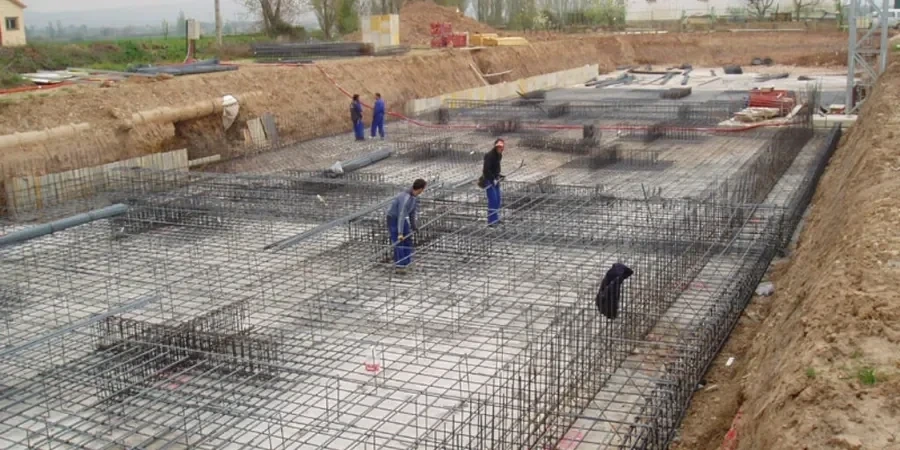
Birmingham’s glacial till can hide lenses of soft clay that cause differential settlement if not identified during shallow foundation design.
Scope of work in Birmingham
Critical ground factors in Birmingham
Birmingham expanded rapidly during the Industrial Revolution. Canals, railways, and factories left a legacy of variable fill and buried obstructions. In areas like Sparkbrook and Nechells, old demolition rubble sits directly below topsoil. If not identified, this fill can compress unpredictably under shallow foundations. We also see swelling clays derived from glacial till in parts of Sutton Coldfield. These shrink and swell with moisture changes. Shallow foundation design must account for these risks. We always recommend a minimum of two trial pits per plot to expose hidden layers before construction begins.
Our services
We offer three complementary services tailored to Birmingham’s ground conditions.
Strip and Pad Foundation Design
Design of continuous strips and isolated pads for low-rise residential and commercial structures. We calculate bearing capacity using SPT N-values and laboratory shear strength. Suitable for Birmingham’s competent sandstone and stiff till.
Raft Foundation Design
Reinforced concrete rafts for sites with variable ground or moderate settlement risk. We model differential movement using finite element analysis. Common in Birmingham’s inner-city regeneration areas with made ground.
Improvement Verification
Post-treatment testing to confirm that improved ground meets design bearing and stiffness targets. We use plate load tests and dynamic probing. Essential for sites in Birmingham where shallow foundation design relies on vibrocompaction or stone columns.
Q&A
What is the typical cost for shallow foundation design in Birmingham?
Our fee for shallow foundation design in Birmingham ranges from £1,600 to £2,410 depending on plot size, number of trial pits, and testing scope. This includes desk study, parameter interpretation, and a design report.
Do I need a site investigation before designing foundations in Birmingham?
Yes, absolutely. Birmingham’s ground varies widely over short distances. A site investigation with trial pits and SPT is the only reliable way to confirm bearing capacity and identify hidden fill or soft clay lenses.
How deep should a shallow foundation be in Birmingham?
Typically minimum 0.9 m to avoid frost heave. In areas with swelling clay, we recommend 1.2 m to stay below the active zone. Depth also depends on the bearing stratum depth identified during investigation.
Can I build on made ground in Birmingham?
It depends on the thickness and composition. Thin made ground (under 1 m) can often be removed and replaced. Thicker fill requires Improvement or a raft foundation. We assess each site individually with trial pits and lab testing.