Birmingham's geology is a study in contrasts. The city centre sits on Keuper Marl, a stiff reddish clay that can swell when wet, while areas like Edgbaston and King's Heath are underlain by glacial till and river terrace deposits. Out towards Sutton Coldfield, the Bunter Sandstone brings coarser, free-draining soils into the mix. This patchwork means classification isn't a one-size-fits-all exercise. A USCS classification that fits a site in Jewellery Quarter may be useless for a development in Bournville. The real challenge lies in distinguishing between the high-plasticity clays (CH) common in the west and the silty sands (SM) found along the River Rea corridor. Without proper soil classification, engineers risk misjudging bearing capacity or settlement behaviour from the outset.
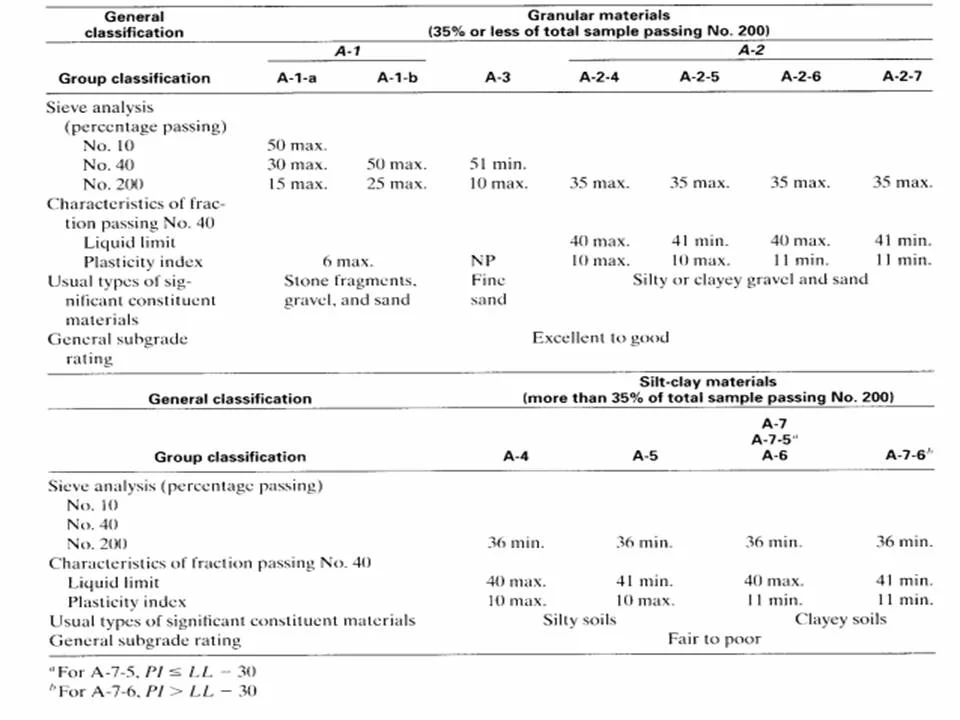
In Birmingham, a liquid limit above 60% on Keuper Marl means the soil almost certainly falls into the CH group — a direct warning for shrink-swell design.
Scope of work in Birmingham
Critical ground factors in Birmingham
In Birmingham, many times we see sites where the Keuper Marl has been disturbed by historical excavation or backfill. That mixed material no longer behaves like the stiff clay in the textbooks. If you classify it purely on recovered samples without checking for fissures or root holes, you can overestimate its strength. The risk is differential settlement under strip footings. Another issue comes with the river terrace sands in Aston and Saltley — these can be loose and collapsible when saturated, especially after heavy rain. A standard AASHTO classification alone won't flag that loose structure. You need the USCS dual symbol (e.g., SM-SP) to capture the gap-graded nature. Ignoring this can lead to unexpected settlement during or after construction.
This service complements our laboratory testing work for a complete project analysis.
Our services
We offer a full suite of soil classification services tailored to Birmingham's ground conditions. Each test follows the applicable British or international standard, with results reported in both USCS and AASHTO formats.
Atterberg Limits Testing
Determination of liquid limit, plastic limit, and plasticity index on cohesive samples from Birmingham's clay formations.
Sieve and Hydrometer Analysis
Full particle size distribution for sands and gravels, including hydrometer for fine fractions down to 0.001 mm.
USCS Group Symbol Assignment
Systematic classification of soil type based on gradation and plasticity, following BS EN ISO 14688-2.
AASHTO Group Index Calculation
Subgrade classification for pavement design, including group index for road projects in the West Midlands.
Q&A
What is the difference between USCS and AASHTO soil classification?
USCS (Unified Soil Classification System) groups soils by grain size and plasticity, giving symbols like CH or SM. AASHTO (M 145) focuses on road subgrade performance, using a group index from 0 to 20+ to indicate suitability. For Birmingham projects, USCS is better for foundation design, while AASHTO is preferred for highways and pavements.
How much does a full soil classification test cost in Birmingham?
A standard classification suite including Atterberg limits, sieve analysis, and USCS/AASHTO reporting typically ranges between £50 and £90 per sample. The final cost depends on volume and whether additional tests like compaction or CBR are needed.
Which soil types are most common in Birmingham for foundation design?
The dominant soil is Keuper Marl, a high-plasticity clay (CH under USCS) found beneath most of the city centre. River terrace deposits along the Rea and Tame valleys produce silty sands (SM) and gravels (SP-SM). In the north, Bunter Sandstone provides sandy soils (SC, SM) with better drainage and bearing capacity.