Eurocode 7 sets the framework for deep soil mixing design in Birmingham, and we apply it rigorously. The city's geology – thick alluvial deposits over Mercia Mudstone – means that untreated ground often fails bearing checks for medium-rise structures. In our experience, a well-calibrated DSM column layout can cut settlement by over 60% compared to untreated ground. We always pair the design with a thorough study of bearing capacity to confirm the target strength is reached before full production begins.
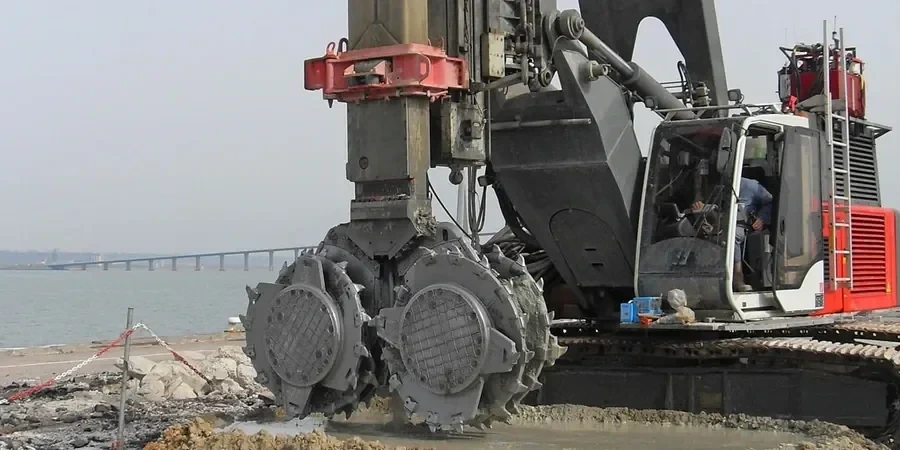
A calibrated DSM column layout can reduce settlement by over 60% on Birmingham's soft alluvial deposits compared to untreated ground.
Scope of work in Birmingham
- Column layout tailored to local stratigraphy
- Binder type selected per soil chemistry (cement, slag, or blend)
- Unconfined compressive strength verified on wet-grab samples at 7 and 28 days
Critical ground factors in Birmingham
Birmingham's groundwater table sits between 2 and 5 m below ground in most districts, and that creates a real risk for deep soil mixing. High pore pressures can wash out fresh binder before it sets, especially during wet winters. We counter this by specifying a water-cement ratio below 0.8 and by sequencing columns so that each fresh panel cures before the adjacent one is drilled. The other hazard is heterogeneous alluvium: a gravel lens can stop the mixing tool from reaching full depth. We detect those lenses through continuous penetration monitoring during drilling.
Our services
We offer four tailored deep soil mixing design services for Birmingham projects – from initial feasibility to full production support.
Feasibility & Binder Optimisation
Laboratory trials using site soil to determine the optimal binder type and dosage. We test three to five mix designs per project and report unconfined compressive strength at 7, 14 and 28 days.
Column Layout & Structural Design
We produce column diameter, spacing and depth layouts based on the target bearing capacity and total settlement limits. All designs are checked against Eurocode 7 limit states.
Installation Supervision & QA
Our engineers attend site during the first two days of production to calibrate mixing parameters – blade rotation speed, penetration rate and binder flow – and to collect wet-grab samples for strength verification.
Long-Term Performance Monitoring
We install settlement plates and inclinometers on a sample of columns to track real-world behaviour over 6 to 12 months. Data is compared against design predictions and reported monthly.
Q&A
What is the typical strength gain timeline for deep soil mixing columns in Birmingham?
Unconfined compressive strength reaches roughly 60-70% of the 28-day value by day 7. For Birmingham's alluvial clays, we expect 0.8 to 1.2 MPa at 28 days with a cement binder content of 250 kg/m³. Strength continues to rise slowly beyond 28 days, typically gaining another 10-15% by 90 days.
How does groundwater affect deep soil mixing design in Birmingham?
High groundwater flow can wash out unset binder, especially in the gravel layers beneath the city centre. We mitigate this by using a water-cement ratio below 0.8 and by adding bentonite (2-4% by binder mass) to reduce bleed. Columns are sequenced so that each fresh panel cures for at least 24 hours before the adjacent one is drilled.
What is the cost range for a deep soil mixing design study in Birmingham?
A full design study – including laboratory binder optimisation, column layout, structural checks and installation supervision – typically falls between £1.220 and £4.240 depending on site complexity and the number of mix designs tested. Larger volumes reduce the per-column cost significantly.