Birmingham sits on a complex mix of glacial till, river terrace gravels, and Mercia Mudstone. With over 1.1 million residents and rapid urban regeneration, the ground beneath the city centre has been reworked for centuries. We see differential settlement risks most often where Victorian fill meets modern loadings. A proper settlement analysis is the only way to quantify how the subsoil will behave under a proposed foundation. Before pouring concrete, we recommend pairing the settlement assessment with a granulometry test to understand particle size distribution in the granular layers that dominate the city’s shallow geology.
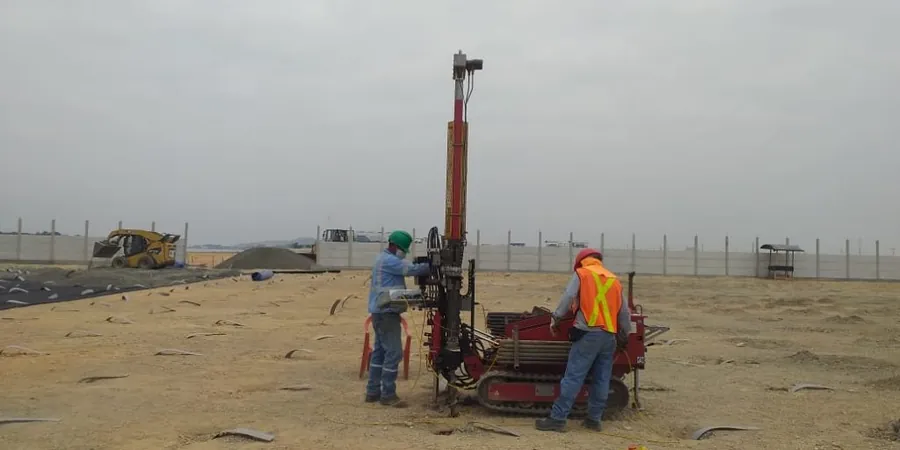
In Birmingham, the biggest settlement risk is not the load itself — it’s the hidden variability of glacial till beneath a Victorian city.
Scope of work in Birmingham
- Compression index (Cc) and recompression index (Cr)
- Pre-consolidation pressure (σ'p)
- Coefficient of consolidation (cv)
- Void ratio and moisture content profiles
Critical ground factors in Birmingham
Birmingham expanded fast during the Industrial Revolution. Factories, canals, and railways left a legacy of uncontrolled fill, old cellars, and buried structures. Many sites in Digbeth and the city core have 3–6 metres of made ground with variable compaction. The risk isn’t just total settlement — it’s differential movement between a new structure and adjacent older buildings. Without a proper settlement analysis, a small extension can crack party walls or sever drainage connections. We always check for past mining activity too; Birmingham sits on the Warwickshire Coalfield fringe, and shallow workings can trigger sudden ground loss.
This service complements our laboratory testing work for a complete project analysis.
Our services
Our settlement analysis service in Birmingham covers the full chain from field sampling to numerical modelling. We tailor the scope to the site history and proposed loads.
Oedometer Testing (One-Dimensional Consolidation)
Incremental loading oedometer tests on undisturbed U100 samples. We measure Cc, Cr, σ'p, and cv for each soil horizon. Results fed directly into settlement predictions.
Finite Element Settlement Modelling
Using Plaxis 2D/3D and Settle3 to simulate immediate, primary, and secondary consolidation. We model staged construction and pore pressure dissipation for realistic predictions.
Settlement Monitoring & Verification
Installation of precise levelling points, extensometers, and inclinometers. Real-time data collection during and after construction to validate our predictions and trigger remedial action if needed.
Q&A
How much does a settlement analysis cost in Birmingham?
For a typical residential extension or small commercial project in Birmingham, expect between £440 and £1,520. The range depends on borehole depth, number of oedometer tests, and whether we include numerical modelling. We provide a fixed quote after a site visit and desk study review.
What is the difference between immediate and consolidation settlement?
Immediate settlement happens as soon as load is applied — it is elastic deformation of the soil skeleton. Consolidation settlement is time-dependent and occurs as pore water is squeezed out of saturated clay layers. In Birmingham’s glacial till, consolidation can last months to years depending on layer thickness and drainage path.
Does Birmingham have areas with high settlement risk?
Yes. The city centre, particularly Digbeth, the Jewellery Quarter, and areas along the Rea Valley, have thick made ground and compressible alluvial deposits. Sites near the former canal network or old railway yards also carry higher risk due to uncontrolled fill and soft spots.