In Birmingham, the ground tells a layered story. You’ve got river terrace gravels overlying Mercia Mudstone, and between them, perched water tables that shift with the seasons. We’ve seen more than one site where conventional grouting just washed out through the open gravels. That’s where jet grouting design becomes the practical answer. By eroding and mixing the soil in situ with a high-velocity cement grout, we create columns or panels that actually stay put. Before we finalise any design, we always review the grading curve and groundwater regime. In Birmingham, that often means coupling our jet grouting design with a careful assessment of settlement risks to avoid differential movement between treated and untreated zones. The local geology demands this extra step.
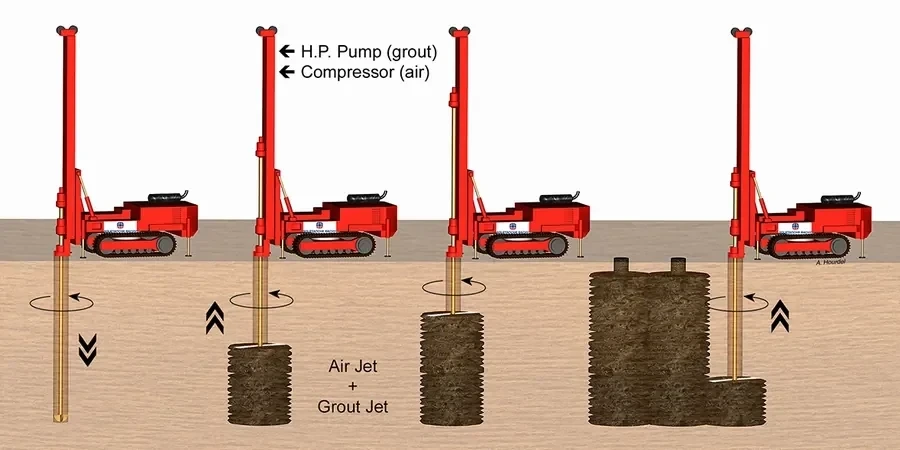
Jet grouting in Birmingham’s river terrace gravels demands a design that accounts for variable permeability and potential washout — a trial area is non-negotiable.
Scope of work in Birmingham
Critical ground factors in Birmingham
The most common mistake we see in Birmingham is assuming that one jet grouting design fits the whole city. A contractor used a standard single-fluid system near the Rea Valley and ended up with columns that barely reached half their design diameter. The gravels there are so open that the grout fluid simply bled away. We had to step in with a double-fluid system and a reduced lift rate to build the columns properly. If you skip the trial and rely on a generic design, you risk wasting both time and material. In Birmingham, geotechnical variability is the rule, not the exception.
Our services
We provide a complete package for jet grouting projects in Birmingham, from initial feasibility through to construction support.
Feasibility and Parametric Study
Review of existing ground investigation data, soil grading, and groundwater conditions to determine the most suitable jet grouting system (single, double, or triple fluid). Includes preliminary column layouts and strength estimates.
Detailed Design and Specification
Calculation of jet parameters, column geometry, treatment pattern, and quality control criteria. Production of tender-ready specifications aligned with BS EN 1997 and CIRIA guidance. Includes waste management provisions.
Trial Area Supervision and Validation
On-site supervision of test columns, core extraction, and laboratory testing (UCS, permeability). Adjustment of design parameters based on trial results before full-scale production.
Q&A
What ground conditions in Birmingham are most suitable for jet grouting?
Jet grouting works well in the river terrace sands and gravels found across the city centre and along the Rea Valley. It also performs effectively in the weathered zone of Mercia Mudstone. The technique is less suited to very soft organic clays or peat, where the column may not form properly.
How much does jet grouting design typically cost in Birmingham?
For a typical commercial project in Birmingham, design fees range from £1,230 to £5,050 depending on ground variability, number of trial columns, and design complexity. This includes the parametric study, detailed specification, and trial supervision. Larger or more complex sites may fall above this range.
What is the difference between single, double, and triple fluid jet grouting?
Single fluid uses only cement grout jetted at high pressure. Double fluid adds an air shroud around the jet to extend the cutting radius. Triple fluid uses water for cutting and grout for filling, which gives better control in cohesive soils. In Birmingham's gravels, double fluid is often preferred for its balance of column diameter and spoil control.
How do you verify that the jet grout columns meet design strength?
We specify trial columns at the start of each project. These are cored 14 to 28 days after installation and tested for unconfined compressive strength (UCS). Permeability tests are also carried out on selected cores. If results fall short, we adjust jet pressure, lift rate, or grout mix before full production begins.