Birmingham expanded rapidly during the Industrial Revolution, with factories and canals built on glacial till and river terrace deposits. These soils vary in stiffness and can settle unevenly under load. We install geotechnical instrumentation to track real-time ground behavior, from inclinometers in retaining walls to piezometers in water-sensitive clays. Combining this with a placa de carga test verifies bearing capacity on site, while densidad cono de arena checks compaction quality in fill areas. Our team handles design and installation across the city, from the Jewellery Quarter to new developments in Digbeth.
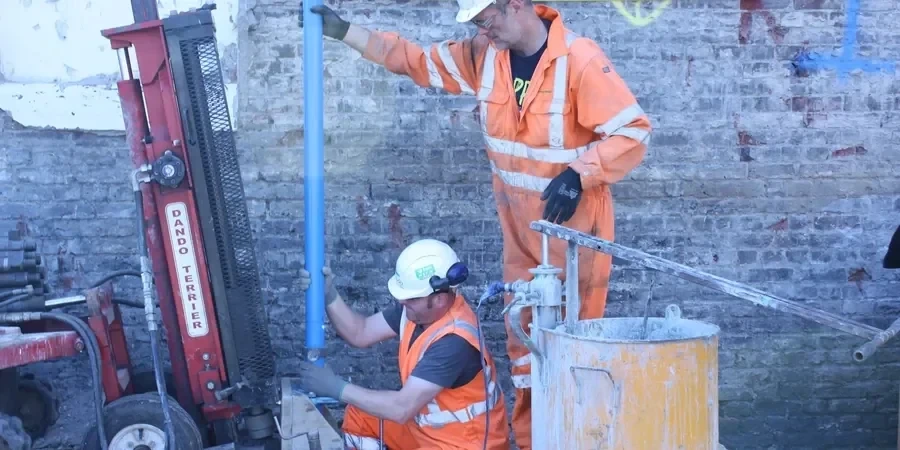
Real-time inclinometer data catches lateral movement before it reaches critical thresholds. Early warning prevents costly structural repairs.
Scope of work in Birmingham
- Inclinometer casings in diaphragm walls and embankments
- Standpipe and vibrating-wire piezometers in cohesive soils
- Settlement markers and extensometers for foundation heave
- Load cells on temporary and permanent anchors
Critical ground factors in Birmingham
Birmingham's wet climate, with annual rainfall around 650 mm, saturates the upper clay layers. Winter rains raise pore pressures, reducing effective stress in cuttings and embankments. If geotechnical instrumentation is omitted, slope failures can develop without warning. Groundwater monitoring with piezometers detects pressure build-up early, and inclinometers track creep movement. We also consider frost heave in shallow foundations during cold snaps, installing thermistors to monitor ground temperature near structures.
Our services
We offer two core geotechnical instrumentation services tailored to Birmingham's ground conditions.
Inclinometer and Piezometer Arrays
Installation of manual or automated inclinometers in boreholes and walls, plus vibrating-wire piezometers in clay and sand strata. Data is logged via dataloggers with remote access. We provide baseline readings and monthly reports.
Settlement and Load Monitoring
Precision settlement markers, rod extensometers, and load cells on anchors or struts. We survey benchmarks to 0.1 mm accuracy. Suitable for high-rise basements and bridge abutments in Birmingham.
Q&A
How much does geotechnical instrumentation design and installation cost in Birmingham?
Typical project costs range from £2,130 to £3,590 depending on sensor count, data-logging requirements, and access constraints. We provide a fixed-price quote after a site walkover.
What sensors do you recommend for clay slopes in Birmingham?
For clay slopes we recommend inclinometers to detect deep-seated movement and vibrating-wire piezometers to monitor pore pressure changes. Both sensors comply with BS EN 1997 and are installed in cased boreholes.
How long does installation take for a typical building site?
Installation usually takes two to four days for a standard array of six inclinometers and four piezometers. Drilling through glacial till may require a longer rig setup. We schedule around your construction programme.
Do you provide remote data monitoring and alarms?
Yes. We install dataloggers with GSM or LoRaWAN telemetry. Alarms are triggered when movement or pore pressure exceeds threshold values. Clients receive email or SMS alerts within minutes.