Birmingham sits on a varied geology of Mercia Mudstone overlain by river terrace gravels and glacial till. The city's post-war redevelopment and the ongoing HS2 programme demand reliable ground parameters for deep foundations and basement excavations. The Ménard pressuremeter test (PMT) measures in situ stress-strain behaviour directly, giving engineers the pressuremeter modulus (EM) and limit pressure (pL) needed for settlement calculations. It avoids the sample disturbance typical of laboratory tests on stiff clays. Before designing a piled foundation in Digbeth or a cut-and-cover tunnel near Curzon Street, a calicata exploratoria combined with PMT provides the ground truth that borehole logs alone cannot deliver.
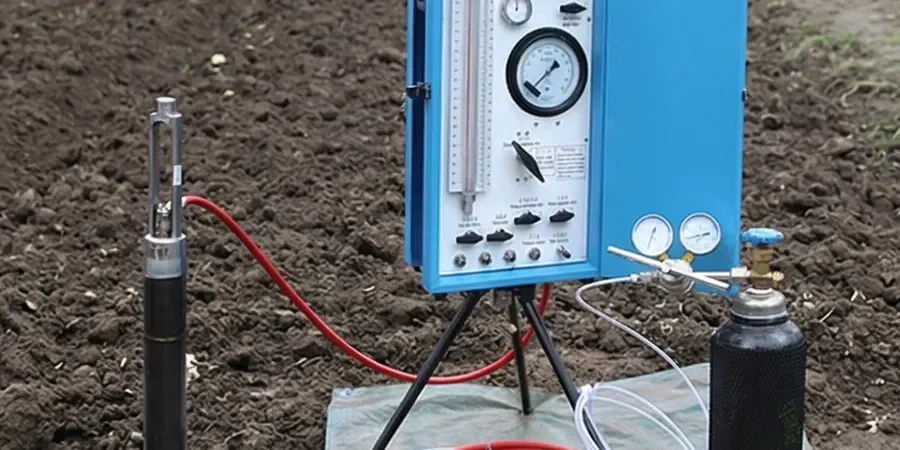
The pressuremeter modulus EM from a Ménard test directly reduces uncertainty in settlement predictions for stiff clays and weak rock — a critical advantage in Birmingham's Mercia Mudstone.
Scope of work in Birmingham
- Pressuremeter modulus EM — used for immediate settlement under shallow foundations.
- Limit pressure pL — correlated with undrained shear strength (cu) for pile design.
- Creep pressure pf — indicates the onset of plastic deformation in overconsolidated clays.
Live process video
Critical ground factors in Birmingham
The Ménard pressuremeter test (PMT) probe is a cylindrical cell 44 mm in diameter, 210 mm long, with three independent chambers. The central measuring cell expands radially into the borehole wall. In Birmingham's variable ground, the main risk is poor borehole quality. If the hole is not straight or the walls are smeared, the probe may not achieve full contact, yielding artificially low modulus values. A second risk involves the overconsolidated nature of the Mercia Mudstone: the probe can induce localised fracturing if inflation rates exceed 0.1 MPa/s. Our technicians calibrate the probe before each test and monitor volume-pressure curves in real time to detect anomalies early.
Our services
We deliver the Ménard pressuremeter test (PMT) as part of a broader geotechnical investigation package. Each service is tailored to the ground conditions and project stage in Birmingham.
PMT in Mercia Mudstone
Pressuremeter testing in stiff to very stiff mudstone, typically 5–20 m depth. We provide EM and pL values for foundation design on high-rise buildings and bridge abutments.
PMT in River Terrace Deposits
Testing in gravelly sands and dense gravels between 2–8 m depth. Results used for bearing capacity assessment of shallow foundations and Improvement verification.
PMT for Basement Wall Stiffness
Horizontal PMT in pre-drilled boreholes to measure lateral modulus for diaphragm wall and secant pile wall design in Birmingham city centre excavations.
Q&A
What is the difference between PMT and SPT for Birmingham soils?
The SPT measures a dynamic resistance (N-value) that correlates with relative density and undrained strength. The PMT measures a static stress-strain curve under controlled expansion, giving direct modulus and limit pressure values. In Mercia Mudstone, PMT provides more reliable settlement parameters because the test loads the soil in a way that mimics foundation behaviour. SPT remains useful for profiling but cannot replace PMT for stiffness-based design.
How deep can the Ménard pressuremeter test reach in Birmingham?
Standard PMT probes are deployed in boreholes up to 30 m depth using NX or HWT sizes. In Birmingham, most tests are performed between 5 m and 25 m, covering the full thickness of the Mercia Mudstone and the underlying Bromsgrove Sandstone where present. Deeper tests require a down-hole wireline system, which we can mobilise for HS2 or deep basement projects.
What is the typical cost range for a PMT investigation in Birmingham?
The cost for a Ménard pressuremeter test (PMT) in Birmingham typically ranges between £850 and £990 per test point, depending on depth, access conditions, and number of tests per borehole. Volume discounts apply for multiple test points on the same site. The price includes probe calibration, on-site execution, data reduction, and a report with EM and pL values.
How long does a PMT take compared to other in situ tests?
A single PMT at one depth takes approximately 20–40 minutes, including borehole preparation, probe insertion, and three loading cycles. A full profile of five tests in one borehole can be completed in half a day. This is slower than SPT (which takes 5 minutes per test) but faster than a plate load test. The time investment is justified by the direct measurement of stiffness and strength.
Can PMT be used in gravelly soils found in Birmingham's river terraces?
Yes, but with caution. In dense gravels, the probe may not achieve perfect borehole wall contact, leading to modulus values that underestimate true ground stiffness. We use a pre-boring technique with a stabilised borehole and a reinforced probe membrane. For critical structures, we recommend combining PMT with a plate load test or a dilatometer test to cross-check results. Our team will advise on the best approach based on the gravel matrix and clast size.