Birmingham's subsurface is dominated by Mercia Mudstone overlain by glacial till and river terrace deposits, a sequence that demands careful driven pile design to achieve reliable end-bearing and shaft friction. The mudstone's variable weathering profile means that refusal depths can shift by several metres across a single site, so we always correlate our pile design with site-specific borehole data and In-Situ. Before finalising resistance factors, we cross-check against capacity of load tests to calibrate empirical correlations for local conditions, ensuring the design matches what the ground actually delivers.
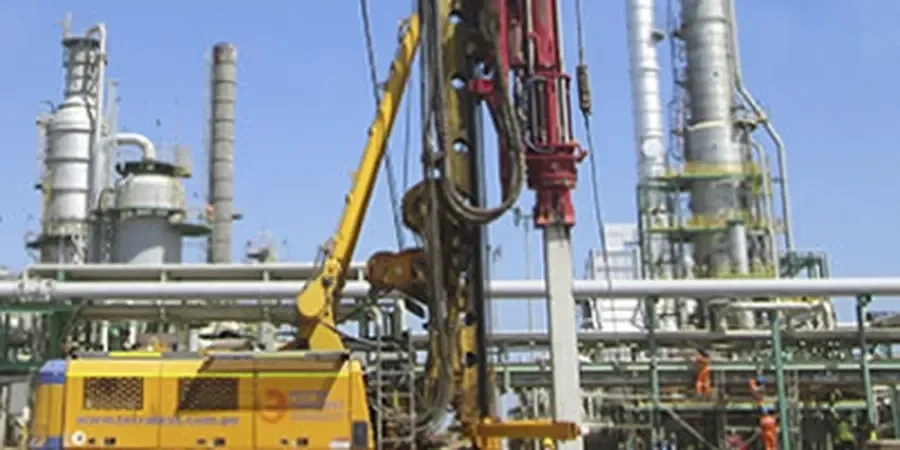
The Mercia Mudstone's weathering profile can shift refusal depth by metres; site-specific driven pile design is non-negotiable for safe foundations.
Scope of work in Birmingham
- Desk study of BGS records and historical mining data to identify potential solution features or old workings.
- Field investigation using SPT and CPT to profile the mudstone weathering grades and to derive skin friction parameters.
- Static and dynamic load testing to verify design assumptions before production piling begins.
Critical ground factors in Birmingham
A recurring issue we see in Birmingham is the presence of thin, dense sand or gravel lenses within the till, which can give misleadingly high SPT blow counts during investigation. If the pile toe stops on one of these lenses, the design may overestimate end-bearing capacity in the underlying mudstone, leading to excessive settlements under working load. Our practice is to always correlate refusal depths with continuous coring of the mudstone and to specify a minimum embedment into fresh rock, typically 3–5 pile diameters, to bypass such misleading layers.
This service complements our laboratory testing work for a complete project analysis.
Our services
Our driven pile design service covers every stage from initial feasibility through to construction verification, tailored to Birmingham's geological setting.
Geotechnical Interpretation & Parameter Selection
We interpret borehole logs and in-situ test data to derive characteristic values for shaft friction and end-bearing, applying partial factors per Eurocode 7 for ultimate and serviceability limit states.
Pile Load Testing & Dynamic Analysis
Static compression tests (maintained load) and high-strain dynamic testing (PDA) are used to validate design assumptions and to refine the pile driving criteria for production piles.
Driveability & Installation Optimisation
Using wave equation analysis (GRLWEAP or similar), we assess hammer-pile-soil interaction to ensure the pile reaches the target depth without damage and with minimal driving stress.
Q&A
What is the typical cost range for driven pile design in Birmingham?
For a typical residential or commercial project in Birmingham, the cost for driven pile design and associated testing ranges from £970 to £3,420, depending on the number of test piles, load test requirements, and site complexity. We provide a fixed-price quotation after reviewing the ground investigation data.
How deep do driven piles usually go in Birmingham's Mercia Mudstone?
Depths vary widely: in areas where the mudstone is near-surface, piles may reach refusal at 8–12 m, while in deeper drift sequences they can extend to 20 m or more. The key is to achieve adequate embedment into fresh or slightly weathered mudstone to mobilise the design end-bearing capacity.
Can driven piles be used in Birmingham's mining-affected areas?
Yes, but only after a thorough desk study and probing to locate old workings. In areas of historical coal mining, we often specify a minimum toe depth below the mine seam and may use driven cast-in-place piles that can be adapted to variable rockhead conditions. The design must account for potential voids and lateral variability.