A common mistake we see on Birmingham sites is relying solely on SPT blows to design foundations in the Mercia Mudstone. That approach misses the thin weak layers and subtle changes in consistency that cause differential settlement. A CPT Cone Penetration Test gives you a continuous record of tip resistance and sleeve friction every 2 cm. It catches those interbedded silt seams that SPT can easily skip. In Birmingham, where the geology transitions from river terrace gravels to mudstone, that resolution matters. We often pair the continuous profile with a veleta de campo test to measure undrained shear strength directly in the clay bands, and later compare results against a compresion simple test on undisturbed samples to validate the correlation.
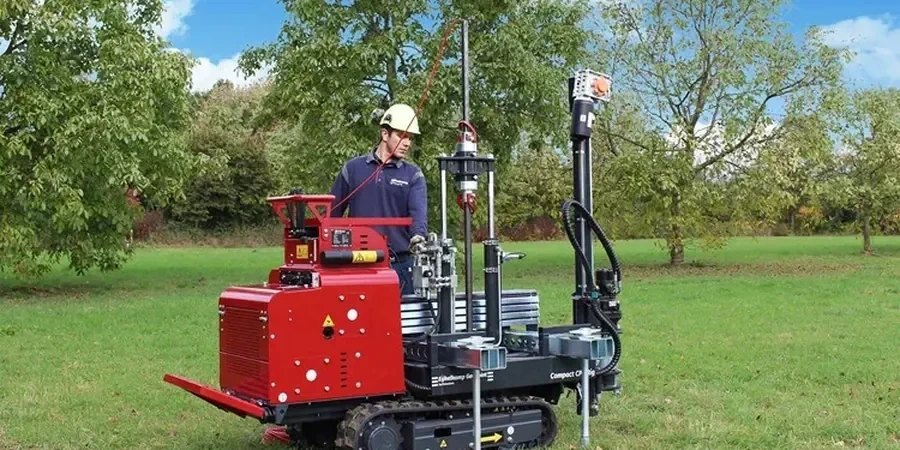
A continuous CPT profile catches the thin weak layers that SPT intervals miss, especially in the weathered zone of Mercia Mudstone.
Scope of work in Birmingham
Critical ground factors in Birmingham
In Birmingham, many times we see engineers design foundations based on SPT N-values from the weathered mudstone zone. That zone can be only 2–3 m thick but contains softened clay with low undrained strength. A CPT Cone Penetration Test identifies that softened layer precisely. Without it, you risk punching shear failure in pad foundations or excessive settlement under strip footings. The continuous profile also detects gravel lenses that cause localised bearing capacity variations. We have seen cases where a site investigation missed those lenses and the contractor hit them during excavation, causing delays. The risk is not just technical – it is financial. A single CPT sounding costs less than one day of delay on a medium-sized housing development in Birmingham.
Our services
We offer three levels of CPT service tailored to Birmingham ground conditions.
Standard CPT sounding
Continuous profiling with tip and sleeve friction. Data logged at 2 cm intervals. Suitable for general foundation design in Mercia Mudstone and river terrace deposits.
CPTU with pore pressure
Includes u2 pore pressure measurement. Dissipation tests at selected depths for consolidation parameters. Used for settlement analysis in soft alluvial clays along the River Tame.
Seismic CPT (SCPT)
Adds vs30/" data-interlink="1">shear wave velocity measurement using a geophone embedded in the cone. Used for dynamic soil properties and liquefaction assessment in granular layers.
Q&A
What is the difference between CPT and SPT in Birmingham soils?
SPT gives discrete N-values every 1–1.5 m, missing thin layers. CPT provides a continuous profile of tip resistance and friction every 2 cm. In the Mercia Mudstone, where weak clay bands are often only 0.3–0.5 m thick, CPT captures them. SPT can also disturb the soil, while CPT is a push test that measures in situ properties.
How deep can a CPT Cone Penetration Test reach in Birmingham?
Typical depth ranges from 15 to 25 m in the river terrace deposits. In the Mercia Mudstone, we often reach 20–30 m before refusal. The maximum depth depends on the cone capacity and the ground conditions. Our 20-tonne rig can push to 40 m in soft clays, but in Birmingham the mudstone usually provides refusal earlier.
What is the typical cost of a CPT in Birmingham?
The cost ranges between £130 and £230 per sounding, depending on depth, access, and whether pore pressure measurements are required. For a standard 15 m CPTU with dissipation tests, expect around £180. Volume discounts apply for multiple soundings on the same site.
Do I need a CPT for a small residential extension in Birmingham?
Often yes, especially if the extension is near a tree or on clay. The continuous profile identifies desiccated clay zones and softened layers near the surface. We have seen cases where a single CPT found a 0.8 m thick soft clay band that would have caused differential settlement. For a two-storey extension, the cost of the test is a fraction of the potential repair.