Birmingham sits on a varied sequence of Mercia Mudstone overlain by river terrace gravels and glacial till, with groundwater levels often shallow near the canals. These conditions demand a diaphragm wall design that accounts for both high lateral earth pressures and potential seepage. A thorough site investigation, including the ensayo SPT to profile strength in the mudstone, is essential before any wall geometry is finalised. The local geology means that wall embedment depths must be carefully calibrated to avoid basal heave in the softer clay horizons.
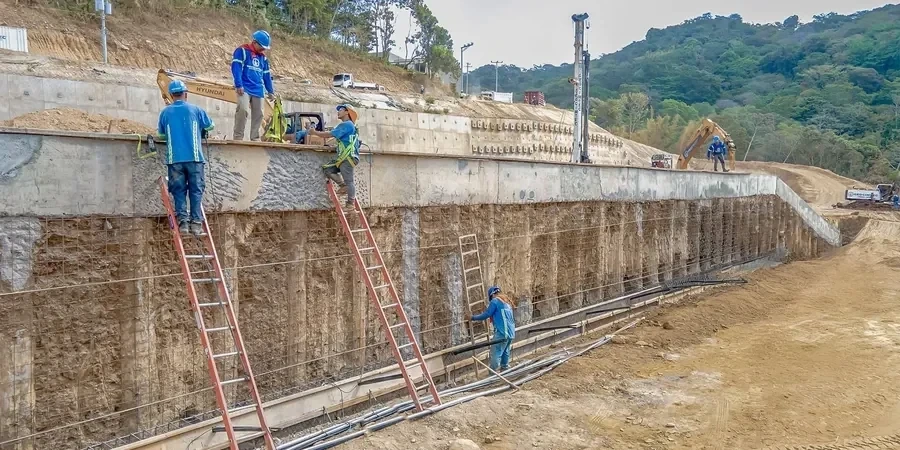
Designing diaphragm walls in Mercia Mudstone demands careful control of slurry density and panel verticality to avoid instability in fissured ground.
Scope of work in Birmingham
Live process video
Critical ground factors in Birmingham
Ground conditions differ markedly between the city centre and outlying suburbs like Sutton Coldfield. In the centre, river terrace gravels over stiff clay can cause sudden loss of bentonite into coarse layers, leading to trench collapse. Out towards the M6 corridor, glacial till with cobbles can obstruct the grab and damage cutting teeth. Both scenarios increase the risk of wall misalignment or panel joint defects, which compromise watertightness. A phased diaphragm wall design with pre-treatment of permeable zones reduces these hazards significantly.
Our services
Our Birmingham diaphragm wall design service covers the full workflow from feasibility to construction support.
Preliminary wall sizing and stability checks
We produce initial wall dimensions and embedment depths based on ground profiles from boreholes, using limit equilibrium methods to verify overall stability against rotation and sliding.
Serviceability and structural detailing
Reinforcement design for bending moments and shear, with crack width control to 0.3 mm for water-retaining structures. We specify concrete cover and joint details per BS EN 1992.
Construction stage monitoring plans
Inclinometer and piezometer layouts to verify wall performance during excavation. We define trigger levels for lateral movement and groundwater drawdown to protect adjacent structures.
Q&A
How deep can diaphragm walls be designed in Birmingham’s Mercia Mudstone?
Depths up to 40 m are feasible using a hydrofraise rig, provided the mudstone is not heavily fractured. The Birmingham Fault zone may limit depths to 25-30 m in some areas. A seismic refraction survey helps map rock quality in advance.
What is the typical cost range for a diaphragm wall design package in Birmingham?
The cost for a full design package including ground model interpretation, structural calculations, and construction drawings typically ranges from £1.300 to £6.180 depending on wall length, complexity, and depth. Final price is confirmed after reviewing site investigation data.
Which Eurocode sections apply to diaphragm wall design in the UK?
Eurocode 7 Part 1 (BS EN 1997-1) covers geotechnical design, while Part 2 handles ground investigation. BS EN 1992-1-1 governs concrete and reinforcement design. The National Annex for the UK provides partial factors specific to retaining structures.
Do you check for basal heave under deep excavations in Birmingham clay?
Yes, basal heave is checked using Terzaghi’s method and finite element analysis. In soft alluvial clays along the River Rea, we often recommend a thicker wall embedment or a stabilising base slab to limit upward movement.