BS 5930 and Eurocode 7 set the framework for evaluating existing pavements, and in Birmingham this is especially relevant due to the city's underlying Mercia Mudstone geology. These low-permeability claystones often sit close to formation level, so pavement layers must be assessed for moisture susceptibility and loss of bearing capacity over time. We combine core extraction, dynamic cone penetrometer (DCP) profiles, and in-situ CBR testing to characterise each structural layer. Our UKAS-accredited (ISO 17025) lab then tests recovered materials for plasticity, grading and California Bearing Ratio. For projects involving road widening or overlay design, we integrate results with a geotechnical road study that evaluates subgrade variability and drainage conditions. This whole approach gives Birmingham's civil engineers a defensible basis for pavement rehabilitation design.
DCP profiles at 200 m intervals combined with soaked CBR testing give Birmingham's engineers a reliable basis for overlay design and pavement rehabilitation.
Scope of work in Birmingham
Critical ground factors in Birmingham
Birmingham's freeze-thaw cycles and high clay content create a specific risk: subgrade heave and loss of support under existing pavements. If an evaluation misses the transition between the Mercia Mudstone and overlying glacial till, you can end up with differential settlement that cracks new surfacing within two winters. We map these changes by correlating DCP profiles with borehole logs from the same corridor. When we detect high-moisture zones, we flag the need for drainage improvements or lime stabilisation before any overlay is placed. Ignoring these local soil transitions is the main cause of premature failure in Birmingham's road rehabilitation projects.
Our services
We deliver four integrated services for existing pavement evaluation in Birmingham, each tailored to the city's geology and traffic loads.
Core Sampling & Layer Identification
Extraction of 100 mm or 150 mm diameter cores through asphalt and base layers. We log thickness, material type, cracking and debonding, then return samples for laboratory characterisation.
Dynamic Cone Penetrometer (DCP) Profiling
Continuous strength profiles along the carriageway at 200 m intervals. Blow counts correlate to CBR and elastic modulus, enabling spatial mapping of weak zones before overlay design.
In-Situ & Soaked CBR Testing
Field CBR tests using a calibrated proving ring, plus 4-day soaked CBR on remoulded subgrade samples in our UKAS-accredited lab. Results directly feed into pavement thickness design.
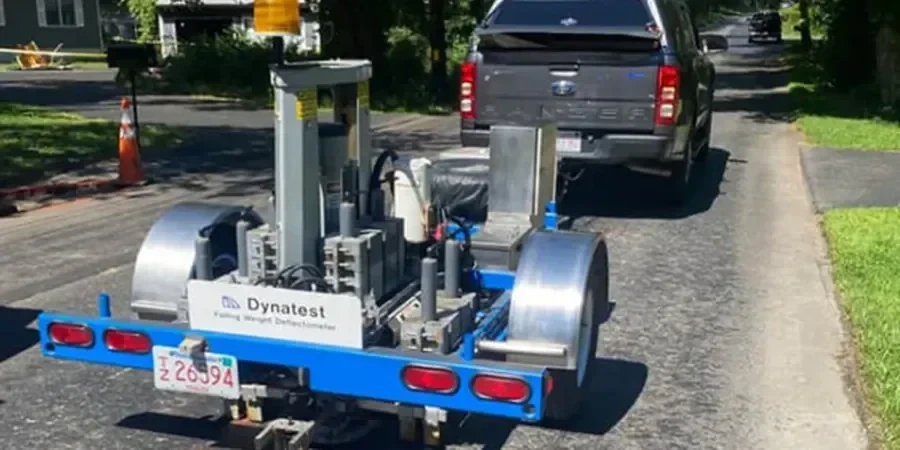
Falling Weight Deflectometer (FWD) Analysis
Non-destructive deflection testing to back-calculate layer moduli. Essential for assessing structural capacity of existing pavements and optimising strengthening or overlay solutions.
Q&A
How much does an existing pavement evaluation cost in Birmingham?
For a typical two-lane carriageway section, the cost ranges between £990 and £3,380 depending on the testing scope — core sampling, DCP profiling, in-situ CBR and laboratory tests. Larger projects with FWD analysis or extensive laboratory suites fall at the upper end of this range.
When should I carry out a pavement evaluation instead of a full ground investigation?
If the structure is still sound but showing surface distress — cracking, rutting, or edge deterioration — a pavement evaluation focused on the existing layers and immediate subgrade is usually sufficient. You would need a full ground investigation if there is evidence of deep-seated slope movement, sinkholes, or if you are changing the road alignment significantly.
What is the difference between DCP and CBR for pavement assessment?
DCP gives a continuous strength profile through the pavement layers and subgrade, identifying weak zones every few centimetres. CBR provides a single bearing strength value at a specific depth. We use DCP to locate problem areas and CBR to quantify the bearing capacity for design. Both are needed for a solid evaluation.