In Birmingham, the ground can change character within a single street. One plot sits on firm Keuper Marl, while the next is underlain by glacial till or river terrace gravels. That variability is precisely why a site-specific factor of safety calculation matters more here than in many other UK cities. We routinely see designs that rely on generic parameters from old maps, only to discover during excavation that the actual shear strength is lower than assumed. A proper FS calculation, grounded in local borehole data and laboratory testing, prevents that mismatch. Before crunching numbers, we always recommend a drainage geotechnical study to understand how water pressures will influence effective stress, and a field vane test to obtain undisturbed undrained strength in cohesive layers. Both feed directly into the stability analysis.
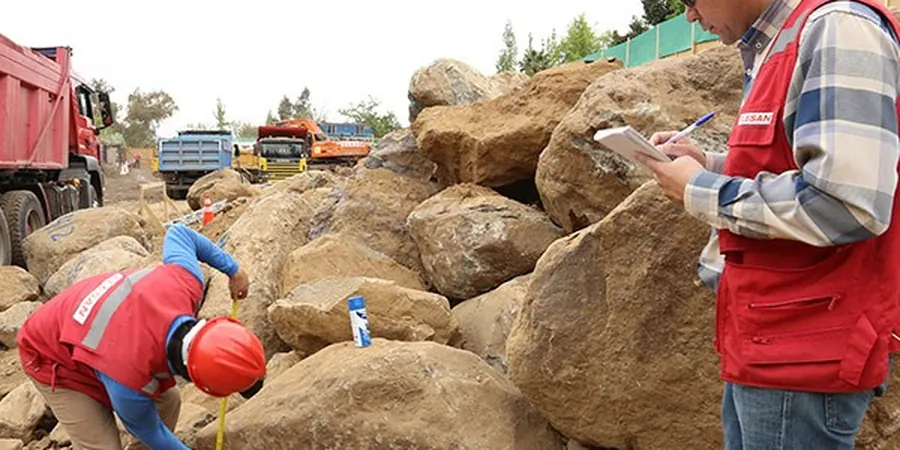
A factor of safety calculated from generic parameters is no safety at all — the ground in Birmingham demands site-specific values.
Scope of work in Birmingham
Critical ground factors in Birmingham
Birmingham sits on some of the most variable glacial geology in the Midlands. The retreating ice sheets left behind a patchwork of lodgement till, outwash sands, and lacustrine clays — sometimes stacked in the same borehole. This heterogeneity creates a real risk: a factor of safety that looks acceptable in one test pit may be unconservative just ten metres away. The seasonal groundwater response adds another layer. After wet winters, the water table in the River Rea valley rises by over two metres, reducing effective stress and the FS of any cut slope. Ignoring this fluctuation has led to a number of shallow landslides along the A38 corridor. A solid analysis must include worst-case phreatic conditions.
Our services
We provide two complementary services to support reliable factor of safety calculations for projects across Birmingham.
Slope Stability Analysis
Limit equilibrium and finite element modelling tailored to Birmingham's glacial till and weathered mudstone. Includes sensitivity analysis for groundwater variation and rapid drawdown scenarios in canal-side developments.
Foundation Bearing Capacity Check
Ultimate limit state verification for shallow and deep foundations using direct shear and triaxial parameters. We calculate the FS against bearing failure, sliding, and overturning for pad, strip, and raft foundations on Birmingham's variable subsoil.
Q&A
What is the difference between global factor of safety and partial factor approach in Eurocode 7?
A global FS uses a single number (e.g. 1.5) applied to the overall resistance, lumping all uncertainties together. Eurocode 7 splits this into partial factors — one for actions (loads), one for material properties, and one for resistance. This allows different levels of confidence for each variable. For Birmingham's variable ground, the partial factor approach is more transparent because it isolates the uncertainty in shear strength from the uncertainty in groundwater levels.
How does groundwater in Birmingham affect the factor of safety?
Groundwater reduces effective stress, which directly lowers shear strength in clays and silts. In the River Rea valley and areas like Digbeth, the water table can rise seasonally by 2 metres or more. A factor of safety calculated for dry conditions may become dangerously low when the ground is saturated. We always model worst-case phreatic surfaces and use Ru coefficients from field permeability tests to capture this effect.
What factor of safety is typically required for temporary excavations in Birmingham clay?
For short-term undrained conditions in stiff clay, we typically target a global FS of 1.3 to 1.5. This follows the guidance in CIRIA C760 and Eurocode 7. However, if the excavation is near a railway or existing structure, the client may require 1.5 or higher to limit movements. The final value depends on the consequence class of the structure and the confidence in the ground model.
How much does a factor of safety calculation cost in Birmingham?
A standard factor of safety calculation for a single slope or foundation, including laboratory testing and reporting, typically ranges from 440 to 1,340 GBP. The variation depends on the number of soil layers, the complexity of the geometry, and whether advanced finite element modelling is needed. We provide a fixed price after reviewing the site investigation data.
Can I use a factor of safety from a nearby site for my Birmingham project?
Not reliably. Birmingham's geology changes rapidly — the Mercia Mudstone can be overlain by sand or till within a few hundred metres. A factor of safety from a site in Harborne may be irrelevant for a site in Aston. We always recommend site-specific parameters from boreholes and laboratory tests. The cost of a wrong assumption far exceeds the cost of a proper FS calculation.