Eurocode 7 and BS 5930 set the framework for investigating made ground across Birmingham, a city where Victorian-era backfill and post-industrial waste pits are common beneath new developments. Our lab applies these standards to every foundations on fill analysis we run, focusing on the variability that makes fill soils notoriously unpredictable. Before we recommend a bearing stratum, we always correlate our findings with a densidad cono-arena field test to verify compaction levels in the fill itself. That on-site control gives us a direct check against laboratory predictions.
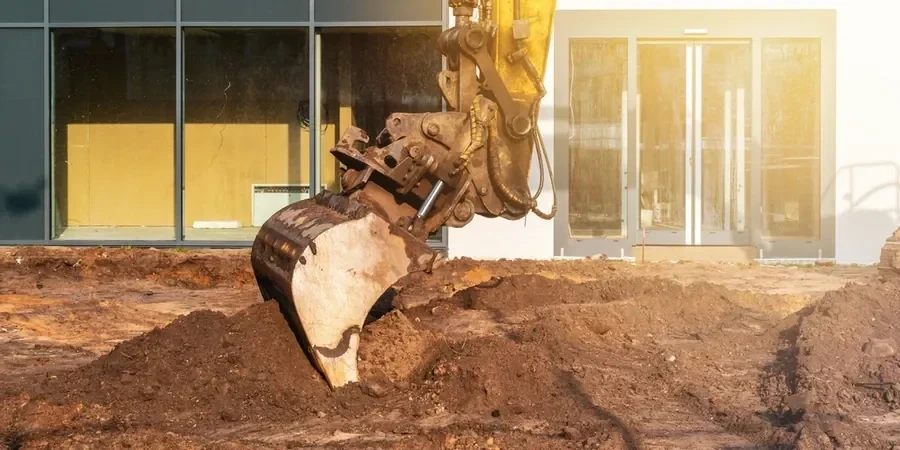
Fill soils in Birmingham can settle unevenly for decades after construction if the analysis does not account for hidden voids or decaying organic content.
Scope of work in Birmingham
Critical ground factors in Birmingham
We bring a 10-tonne tracked rig with hydraulic percussion hammer to Birmingham sites, capable of drilling through buried concrete and dense slag layers that stop lighter kit. The rig can reach depths of 10 m or more, letting us test the full fill profile and the underlying natural ground. For shallow fills we also deploy a hand-held dynamic cone penetrometer to map variability quickly. Every rig carries a full set of sampling tools and a field laboratory trailer so we can log moisture content and density on the spot.
Our services
Our Birmingham lab delivers four core services for foundations on fill analysis, each tailored to made ground conditions.
Trial Pit Excavation & Logging
Machine-dug pits to 4 m depth in fill, with full face logging and undisturbed sampling for lab testing.
Dynamic Probing (DPH)
Continuous penetration profiles in fill to map stiffness variation and locate soft spots or voids.
Collapse Potential Testing
Double oedometer tests on undisturbed fill samples to quantify wetting-induced settlement under load.
Compaction Verification
Field density tests (sand replacement & nuclear gauge) plus laboratory Proctor compaction to check fill quality.
Q&A
Why is foundations on fill analysis critical for Birmingham developments?
Birmingham has extensive areas of made ground from canals, railways, and heavy industry. Fill depth and composition vary wildly within a single site. Without a proper analysis, differential settlement can crack building slabs and retaining walls within years.
How much does a foundations on fill study typically cost in Birmingham?
For a typical medium-sized residential plot, the study including trial pits, sampling, and laboratory testing costs between £640 and £2,180. The final price depends on fill depth, number of test locations, and the range of lab tests required.
What British standards apply to fill investigations?
BS 5930:2015 covers the investigation methodology, while Eurocode 7 (EN 1997-1:2004) governs the geotechnical design. For sampling and testing we follow BS EN 1997-2:2007 and specific ASTM methods where needed.