On a recent project near the Aston Expressway, we faced a 6-meter embankment that had developed tension cracks after heavy winter rains. The client needed a fast, cost-effective fix without importing granular fill. That's where geocell design entered the picture. By confining the on-site clayey sand with a 200-mm high cellular system and backfilling with local recycled aggregate, we achieved a working platform capable of supporting 40-tonne construction traffic within a week. This is the kind of pragmatic solution Birmingham projects often require, where tight urban sites and variable glacial till deposits demand flexible reinforcement strategies. Before specifying the cell geometry, we always run a plate load test on the subgrade to calibrate the confinement model.
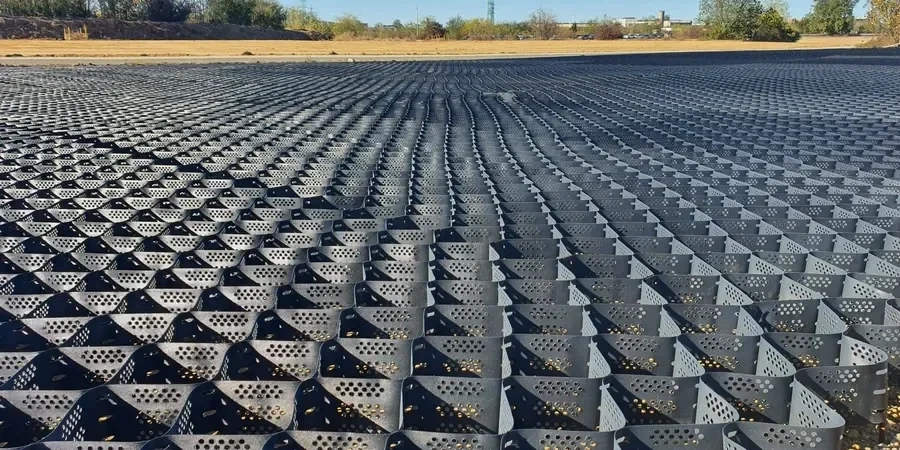
The measured CBR on a Birmingham till subgrade can vary from 1.5% to 6% within 20 meters; geocell design must be site-specific, not generic.
Scope of work in Birmingham
Critical ground factors in Birmingham
Birmingham grew rapidly during the Industrial Revolution, with canals and railways cutting through natural drainage paths. Many of the city's brownfield sites have made-ground over soft alluvium or compressible organic deposits. A common risk we see is underestimating the long-term creep of the subgrade under sustained loading, especially when geocells are used for permanent access roads over peat lenses. Without a proper creep assessment per BS 8006, the cells can bulge laterally and the infill can migrate into the soft subgrade. Another issue is using geocells on slopes steeper than 1:1.5 without calculating the pullout resistance of the tendon anchors. In one case near the Bull Ring, a 1.2-meter high retaining wall built with geocells failed after a week because the infill was too fine and the cells distorted under hydrostatic pressure from a blocked drain. We always design for worst-case groundwater conditions.
Our services
Our geocell design service covers the full workflow from site investigation to construction support. We tailor each solution to Birmingham's ground conditions.
Slope stabilization with geocells
Design of cellular confinement systems for embankments and cut slopes up to 1:1.5 gradients, including anchor trench details and drainage integration.
Load support platforms
Geocell-reinforced working platforms for crane outriggers, heavy haul roads, and temporary staging areas on low-CBR subgrades common in Birmingham's alluvial areas.
Erosion control on drainage channels
Vegetated geocell linings for swales, ditches, and canal banks, designed to handle Birmingham's average annual rainfall of 750 mm without scour.
Retaining wall solutions
Gravity and mechanically stabilized earth walls using geocells as facing units, designed per Eurocode 7 for heights up to 3 meters.
Q&A
What is the typical cost for a geocell design in Birmingham?
For a standard slope stabilization or load support project, the design and documentation fee ranges between £580 and £2,290 depending on site area, complexity, and the number of cross-sections required. This includes a site walkover, subgrade testing, and a design report with construction drawings.
How does the glacial till in Birmingham affect geocell performance?
Glacial till in Birmingham is often stiff but can contain sand lenses and soft clay pockets. The variable CBR means we must test at multiple locations. Geocells work well on till because the confinement prevents lateral spreading, but the cell height must be increased if the till has a low CBR (below 2%).
Can geocells be used for permanent road foundations?
Yes, but only if the subgrade creep is assessed per BS 8006. For permanent roads, we recommend a 200-mm minimum cell height with a compacted crushed stone infill and a geotextile separator below the cells to prevent migration of fines. Long-term monitoring of settlements is advisable for the first 12 months.
What infill material works best for geocells on Birmingham sites?
Crushed limestone or recycled concrete aggregate (40-70 mm) performs well for load support. For vegetated erosion control, we use a 50/50 blend of topsoil and coarse sand. Avoid single-sized gravel or rounded river cobbles, as they do not interlock properly within the cells.