Birmingham sits on the Mercia Mudstone Group, a sequence of red silty clays and sandstones with variable groundwater levels. These low-permeability soils create natural barriers but also present challenges for containment. When we specify a geomembrane in Birmingham, we account for the local clay's potential to shrink and swell. A 1.5 mm HDPE textured geomembrane might be ideal for a steep slope on a landfill cap, while a 1.0 mm LLDPE liner suits a lagoon with differential settlement. We always pair the selection with a detailed interface friction study on the subgrade clay to ensure sliding stability. That local data is non-negotiable for a safe design.
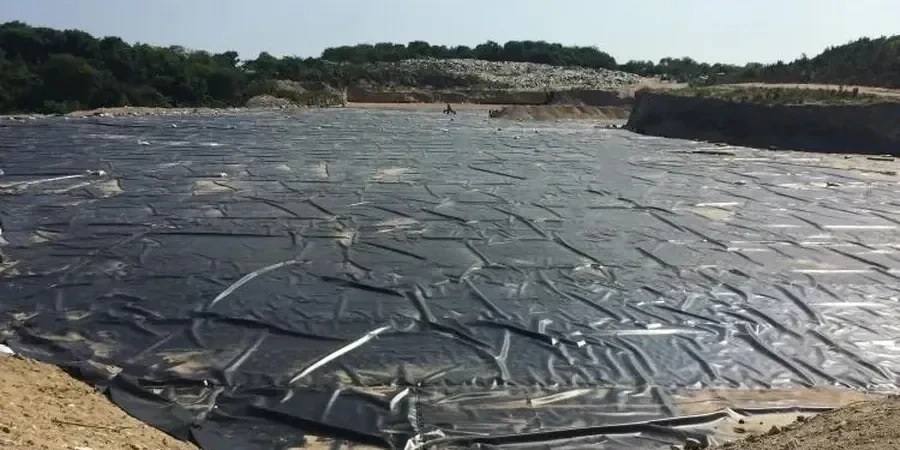
A 1.5 mm textured HDPE geomembrane on a 3:1 slope over Mercia Mudstone requires a minimum interface friction angle of 22 degrees to avoid sliding failure.
Scope of work in Birmingham
- Material selection: HDPE vs LLDPE vs fPP based on chemical exposure and settlement tolerance
- Thickness: 1.0 mm to 2.0 mm depending on subgrade conditions and installation stress
- Seam testing: destructive and non-destructive (air lance, vacuum box, spark test)
- Interface friction: direct shear tests on geomembrane-soil and geomembrane-geotextile interfaces
Critical ground factors in Birmingham
The main risk in Birmingham is the Mercia Mudstone's variable behaviour. When these clays dry they crack, forming preferential flow paths that undermine a geomembrane's integrity. Combine that with Birmingham's average annual rainfall of 650 mm and you have a real uplift risk. A gas venting layer below the liner and a properly designed ballast layer above are essential. Without a site-specific geomembrane specification, you risk punctures from angular gravel in the drainage layer or tensile failure from differential settlement. We always model the anchor trench detail for the local frost depth of 450 mm to prevent frost jacking.
Our services
We provide complete geomembrane specification services in Birmingham, from material selection through to installation quality assurance. Each service is tailored to the site's geology and project risk profile.
Material Selection & Design
We analyse the site's chemical environment, settlement potential, and slope geometry to choose the right polymer, thickness, and surface texture. Deliverables include a specification sheet with full material property requirements per GRI GM13 or GM17.
Seam Testing & QA/QC
On-site destructive and non-destructive seam testing using air lance, vacuum box, and spark test methods. Each weld is logged, and peel/shear strengths are verified against project acceptance criteria. We issue a certified test report per BS 1377.
Interface Friction & Stability Analysis
Direct shear testing on geomembrane-soil and geomembrane-geotextile interfaces using site-specific subgrade clay. We provide the interface friction angles needed for your slope stability model, ensuring compliance with Eurocode 7 slope design requirements.
Q&A
What is the typical cost range for a geomembrane specification service in Birmingham?
For a standard landfill cap or lagoon liner project in Birmingham, our specification and QA/QC services range between £500 and £1,340 depending on site area, number of seams, and testing frequency. This includes material selection, seam testing, and interface friction analysis. Larger projects with multiple liner layers or complex geometries may fall at the upper end of that range.
What geomembrane thickness do you recommend for Birmingham's clay subgrades?
For Mercia Mudstone subgrades with moderate differential settlement, we typically specify 1.5 mm HDPE. If the subgrade is very soft or has high organic content, we step up to 2.0 mm LLDPE for better elongation and puncture resistance. The final thickness depends on the overburden load and installation stress expected.
Do you test the interface friction between the geomembrane and Birmingham clay?
Yes, absolutely. We perform direct shear tests on the actual site clay at its in-situ moisture content against the proposed geomembrane surface. This gives us a realistic interface friction angle for the slope stability analysis. A textured geomembrane on Mercia Mudstone typically yields 22 to 26 degrees, but we always test rather than assume.
What seam testing methods do you use on geomembrane installations?
We use both non-destructive methods (air lance for fusion welds, vacuum box for extrusion welds, and spark test for conductive-backed liners) and destructive peel/shear tests per BS 1377. Destructive samples are taken every 150 metres of weld and tested on-site with a portable tensiometer. All results are documented in a certified QA report.