We were called to a site on Bristol Road South where a new utility tunnel had to pass through a sequence of soft alluvium overlying weathered Mercia Mudstone. The ground was water-bearing and the tunnel face kept collapsing during the first attempt. That project taught us that standard borehole logs alone are not enough for soft soil tunnels. You need a full geotechnical analysis that includes in-situ shear strength, permeability, and deformation modulus. Before setting the tunnel alignment, we ran a series of MASW surveys to map the VS30 profile and identify low-velocity zones that could trigger face instability. The data allowed the contractor to adjust the EPBM parameters and avoid a complete shutdown.
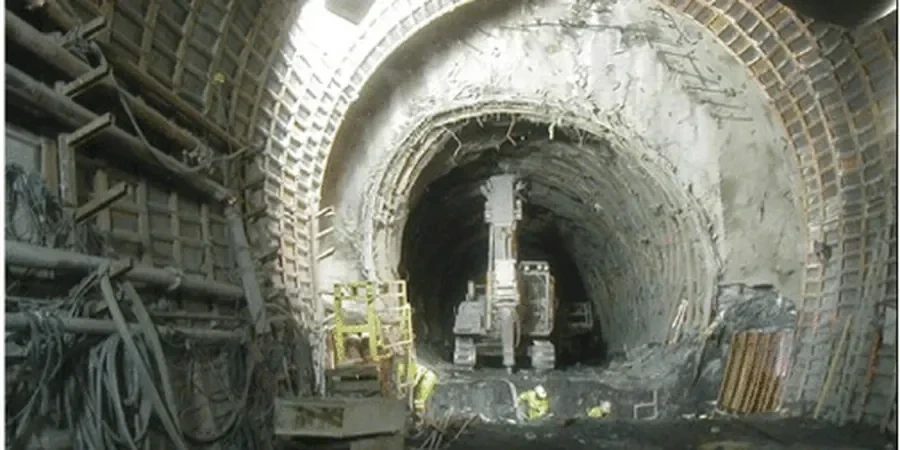
Soft soil tunnels in Birmingham demand site-specific stiffness and strength data; regional correlations from other UK cities often underestimate the glacial till's heterogeneity.
Scope of work in Birmingham
- Short-term undrained stability during excavation
- Long-term drained settlements from pore pressure dissipation
- Impact of gypsum dissolution on the tunnel lining
Critical ground factors in Birmingham
Birmingham sits on a thick sequence of Mercia Mudstone that contains gypsum and anhydrite. These minerals dissolve slowly in groundwater, creating unpredictable voids and collapse zones. In 2018, a sewer tunnel in the Digbeth area encountered a 3-metre cavity that required emergency grouting and a realignment. Our geotechnical analysis for soft soil tunnels in Birmingham always includes a dissolution risk assessment using groundwater chemistry and borehole camera surveys. Without that step, the tunnel could encounter a sudden loss of ground that no amount of face pressure can control. We also run coupled flow-deformation analyses to predict settlement troughs in the overlying streets and buildings.
Our services
Our geotechnical analysis for soft soil tunnels covers the full cycle, from desktop study to instrumented monitoring. We tailor each package to the tunnel's depth, diameter, and the local ground conditions.
Ground Investigation for Tunnels
Rotary cored boreholes with SPTs, in-situ vane tests, and downhole geophysics. We log Mercia Mudstone weathering profiles and identify gypsum bands.
Numerical Modelling of Tunnel-Soil Interaction
2D and 3D finite-element models using PLAXIS and FLAC. We simulate excavation sequences, face pressures, and consolidation settlements.
Instrumentation and Monitoring
Installation of inclinometers, piezometers, and settlement markers. Real-time data feeds for early warning during tunnel advance in Birmingham's soft soils.
Q&A
What is the typical cost of a geotechnical analysis for a soft soil tunnel in Birmingham?
The range is between £2.930 and £14.390 depending on tunnel length, number of boreholes, and the complexity of the ground model. A small utility tunnel might fall at the lower end; a metro tunnel with multiple cross-passages will be at the upper end.
Which soil parameters are most critical for tunnel design in Birmingham's Mercia Mudstone?
Undrained shear strength and the modulus of elasticity are the two key parameters. The mudstone's stiffness drops significantly when weathered, and gypsum dissolution can create localised weak zones that govern the lining design.
How do you account for groundwater in the analysis?
We install standpipes and vibrating-wire piezometers to measure pore pressures at tunnel depth. The data feeds into transient seepage models that calculate inflow rates and the risk of piping at the tunnel face.
Do you use the same approach for both open-face and closed-face tunnelling?
No. For open-face methods (hand-dig, NATM), we focus on stand-up time and face stability. For EPBMs or slurry shields, we provide grain-size distributions, plasticity indices, and foam conditioning parameters to optimise the excavation.
Can you analyse settlement risks for adjacent buildings?
Yes. We run empirical methods (Peck's formula) and finite-element models to predict trough width and maximum settlement. We then compare the predicted values against the building's foundation type and structural condition to define alarm thresholds.