In Birmingham, the term 'ground improvement' encompasses a suite of geotechnical techniques designed to enhance the engineering properties of soil and rock, ensuring stability, durability, and safety for construction projects. As a city with a rich industrial heritage and a current trajectory of extensive urban regeneration, the need for reliable improvement methods is critical. From the redevelopment of brownfield sites in Digbeth to the expansion of transport infrastructure like HS2, the ground beneath Birmingham often requires intervention to meet the demands of modern engineering. This category covers the full lifecycle of ground enhancement, from initial site investigation and geotechnical instrumentation to the design and execution of specialised techniques that mitigate risks such as settlement, liquefaction, and slope instability.
Birmingham's underlying geology presents a complex and often challenging environment that directly dictates the choice of ground improvement strategy. The city is underlain by a succession of Triassic sandstones and mudstones of the Sherwood Sandstone and Mercia Mudstone groups, which are frequently overlain by a patchwork of Quaternary glacial tills, sands, and gravels. More critically, the legacy of centuries of mining and heavy industry has left a mantle of made ground and contaminated fill across large areas. These artificial deposits are notoriously heterogeneous, compressible, and can contain obstructions or hazardous materials. Understanding this geological lottery is paramount; for instance, loose, water-bearing sands in the river valleys may be susceptible to dynamic compaction, while the soft, cohesive alluvium requires a different approach entirely.
Any ground improvement scheme in the UK must strictly adhere to a robust framework of standards and regulations, with Eurocode 7 (BS EN 1997) forming the backbone of geotechnical design. This is supplemented by the UK National Annexes and a suite of execution standards, such as BS EN 14679 for deep mixing and BS EN 14475 for reinforced fill. Crucially, the specification and verification of improvement works are governed by the UK Specification for Ground Treatment, a fundamental document that defines the testing regimes and acceptance criteria. Environmental regulations, particularly those concerning waste classification and the handling of contaminated soils under the Environmental Protection Act 1990, are inseparable from the process. A contaminated soil remediation strategy is often a prerequisite before any structural improvement can commence, ensuring compliance with planning conditions and protecting controlled waters.
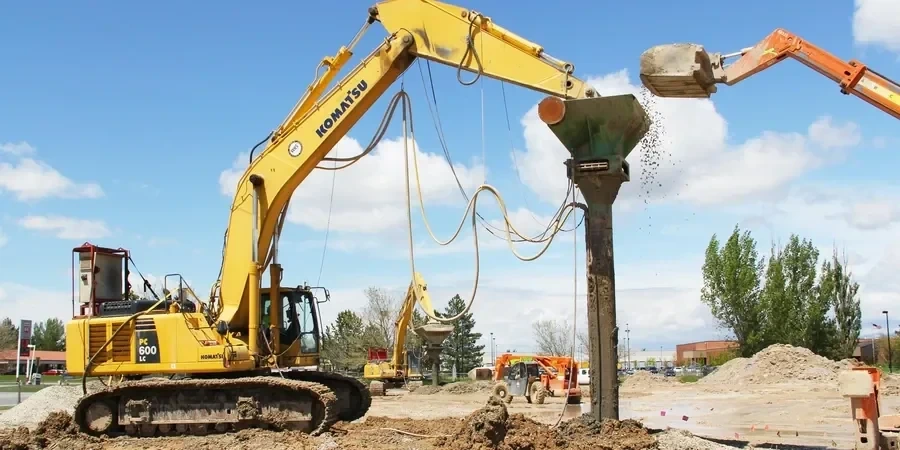
The types of projects requiring ground improvement in Birmingham are diverse and reflect the city's ongoing transformation. Large-scale residential and commercial developments on former industrial parks frequently demand a combination of techniques. For example, the deep foundations for a high-rise in the city centre might utilise grouting design to control groundwater inflow during excavation and to strengthen the bedrock. Conversely, the construction of new warehousing and logistics hubs on the urban fringe often benefits from dynamic compaction design to densify loose granular fills, providing a cost-effective alternative to piling. Infrastructure projects, including road widening and flood defence works, rely on sophisticated geotechnical drainage design to manage pore water pressures and ensure long-term stability of earthworks and retaining structures.
Available services
Contaminated soil remediation
→ Ver detalleDeep Soil Mixing (DSM) design
→ Ver detalleDynamic compaction design
→ Ver detalleGeogrid specification
→ Ver detalleGeomembrane specification
→ Ver detalleGeotechnical drainage design
→ Ver detalleGeotechnical instrumentation (design and installation)
→ Ver detalleGrouting design
→ Ver detalleJet grouting design
→ Ver detalleLandfill geotechnics
→ Ver detalleLime and cement stabilization
→ Ver detalleOrganic soil management
→ Ver detallePrefabricated vertical drain (PVD) design
→ Ver detalleStone column design
→ Ver detalleUnsaturated soil analysis
→ Ver detalleVibrocompaction design
→ Ver detalleQ&A
What is ground improvement and when is it necessary on a site in Birmingham?
Ground improvement is the process of modifying the physical properties of in-situ soils to make them suitable for construction. In Birmingham, it is frequently necessary due to the prevalence of weak alluvial soils, compressible made ground from the city's industrial past, and old mine workings. It is required when the natural ground cannot safely support the proposed loads, or when settlement, slope instability, or liquefaction risks must be mitigated to meet UK building standards.
How do I know which ground improvement technique is right for my project?
Selecting the correct technique depends on a detailed ground investigation that characterises soil type, strength, compressibility, and groundwater conditions. The choice is then guided by the structural loading, settlement tolerances, and site constraints. For example, dynamic compaction suits loose granular soils, while deep soil mixing is effective for soft clays. A competent geotechnical designer will evaluate these factors against the requirements of Eurocode 7 to propose a technically and economically viable solution.
What are the key UK regulations governing ground improvement works?
Ground improvement in Birmingham is governed primarily by Eurocode 7 (BS EN 1997) for geotechnical design and the UK Specification for Ground Treatment for execution and testing. Environmental aspects are controlled by the Environmental Protection Act 1990, especially when dealing with contamination. Any materials used, such as grouts or geosynthetics, must have appropriate CE marking or UKCA marking, and works must comply with the CDM 2015 regulations for health and safety.
Can ground improvement be used to remediate contaminated land?
Yes, ground improvement and contaminated land remediation are often integrated processes. While physical improvement techniques like mixing or grouting can stabilise and solidify contaminants in place, they are distinct from remediation methods like soil washing or bioremediation. A comprehensive strategy, designed in accordance with Land Contamination Risk Management (LCRM) guidance, will often combine a remediation approach to break down or remove pollutants with a ground improvement scheme to enhance the geotechnical properties of the treated material for redevelopment.