Birmingham sits on a complex sequence of glacial till, river terrace gravels and Triassic sandstone, with the water table often encountered within 3–5 m of the surface in the Digbeth and Aston areas. This variability demands a grouting design that accounts for both permeability contrasts and the risk of hydrofracture in the finer-grained layers. We approach each project by first reviewing borehole logs and existing site data, then selecting the appropriate suspension or solution grout — cementitious for the coarser gravels, chemical grouts where finer sands dominate. The aim is always to reduce overall permeability to below 1×10⁻⁶ m/s or to achieve the specified strength gain in treated zones. Because Birmingham’s bedrock depth can shift from 10 m to over 30 m within a single site, a rigid design recipe rarely works; we tailor the injection programme to the actual ground conditions revealed during the early stages of work. Before mobilising equipment, we often recommend a complementary permeability field test to confirm the target horizon’s response, and a classification of soils to refine the grout mix design.
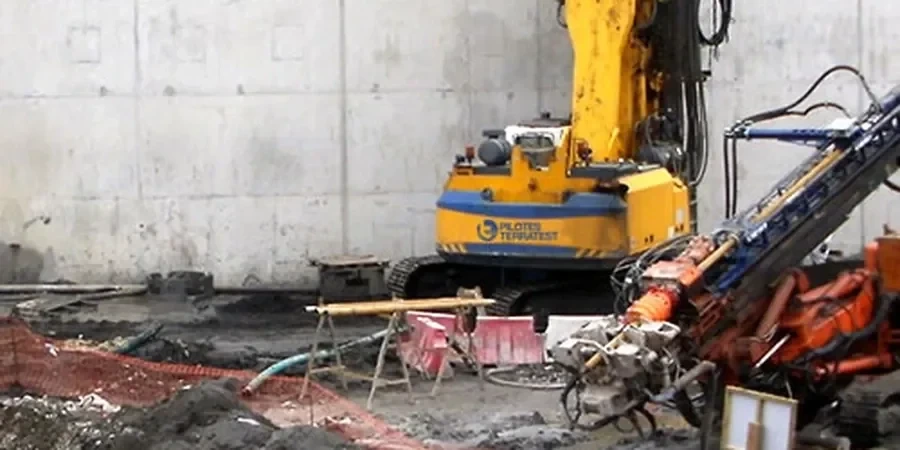
A rigid grouting design recipe rarely works in Birmingham; we tailor the injection programme to the actual ground conditions revealed during early work.
Scope of work in Birmingham
- We apply the GIN (Grouting Intensity Number) concept to control volume and pressure in real time, preventing uncontrolled lifting of the overburden.
- For projects near the canal network or the River Rea, we incorporate a stop‑start sequence to avoid grout migration into open water.
Critical ground factors in Birmingham
Birmingham’s population of over 1.1 million and its dense urban fabric mean that any unplanned ground movement during grouting can affect adjacent buildings, utilities or the extensive tunnel network beneath the city centre. The risk is real: uncontrolled hydrofracture in the till can cause surface heave of 10–20 mm, enough to crack a masonry façade. Our grouting design incorporates a pressure‑controlled shut‑off triggered when the injection rate exceeds the target by 20 % at a given pressure, and we install settlement markers along the treatment corridor. For works near the Bull Ring or the Mailbox, where basement walls are close, we combine the grouting programme with a detailed instrumentation and monitoring plan to detect any deviation early.
Our services
We provide two complementary grouting design services in Birmingham, each adapted to the local ground profile and project constraints.
Permeation & compaction grouting design
For sites underlain by gravels and coarse sands, we design permeation grouting programmes using cementitious suspensions with controlled w/c ratios, and compaction grouting for loose fill or voided ground. Each design includes injection sequence, spacing, pressure limits and a quality control protocol based on post‑grout permeability testing.
Chemical & resin grouting design
Where groundwater chemistry or finer soils preclude cement grouts, we specify low‑viscosity chemical solutions or polyurethane resins. Our designs cover gel‑time adjustment, injection pressure limits for confined zones, and verification via core sampling. This service is frequently used for Birmingham’s canal‑side and former industrial sites.
Q&A
What is the typical cost range for a grouting design in Birmingham?
For a standard project including site review, design report and injection specification, the fee typically falls between £900 and £3.760, depending on the complexity of the ground, the number of injection phases and the volume of verification testing required.
How long does a grouting design study take?
A straightforward design for a single treatment zone can be completed in 3–5 working days once the site investigation data is available. More complex projects — for example, a tunnel face treatment or a dam curtain — may require 2–3 weeks to allow for iterative modelling and sensitivity analysis.
Can grouting be used to treat old mine workings in Birmingham?
Yes, but the approach differs from standard Improvement. For shallow mine workings (common in the Sandwell and Dudley areas bordering Birmingham), we design a bulking grout with a high water‑to‑cement ratio and low pressure to fill voids without collapsing the roof. A chemical grout may be added to control setting time in flowing water conditions.
What verification is carried out after grouting?
We typically specify a combination of post‑grout permeability testing (falling‑head or Lugeon), core drilling through treated zones to check grout penetration, and, where relevant, cross‑hole sonic logging to confirm continuity. The verification programme is detailed in the design report before work starts.