Birmingham sits on a varied sequence of glacial till, river terrace sands, and mudstones of the Mercia Mudstone Group. The water table in the city centre often sits between 2 and 5 metres below ground, which means understanding the permeability of these layers is essential for basement designs and drainage schemes. We perform laboratory permeability tests using both falling head and constant head methods, matching the technique to the soil type. For fine-grained materials like the local till, falling head is the standard approach, while clean sands from the river terraces require constant head conditions. The results feed directly into dewatering designs, slope stability analyses, and foundation drainage layouts. Before proceeding with a deep excavation, we typically recommend combining this test with an analysis of liquefaction potential to assess seismic risks in saturated sands.
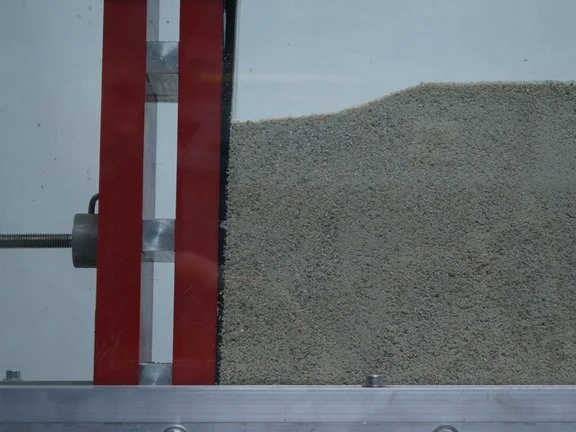
The difference between a k of 1×10⁻⁹ m/s and 1×10⁻⁶ m/s can mean the difference between a dry excavation and a dewatering nightmare in Birmingham's layered ground.
Scope of work in Birmingham
Critical ground factors in Birmingham
The most common mistake we see on Birmingham sites is assuming the till is uniformly low-permeability. In reality, the till often contains sand lenses and weathered zones that create preferential flow paths. If you rely on a single falling head test on a block sample, you might miss these features. The result is a dewatering system that is undersized, leading to delays and cost overruns. We always advise testing multiple specimens from different depths and, where possible, correlating lab results with in-situ packer tests to capture the variability inherent in glacial deposits. Ignoring this heterogeneity is one of the fastest ways to blow a project budget.
Our services
Our Birmingham-based geotechnical laboratory offers two standard permeability testing procedures. We select the method based on the material encountered and the design parameter required.
Falling Head Permeability Test
Designed for fine-grained soils such as clays and silts. The test measures the rate of water level drop in a standpipe connected to a saturated specimen. We use triaxial cell setups to apply back pressure and effective stress representative of field conditions. Results are reported as the coefficient of permeability at a specified void ratio.
Constant Head Permeability Test
Intended for granular soils like sands and gravels. A steady hydraulic gradient is maintained across the specimen, and the outflow volume is measured over time. This method yields a direct k value under laminar flow conditions. We can test at different densities to simulate compaction states typical of engineered fills.
Q&A
What is the difference between falling head and constant head permeability tests?
Falling head is used for low-permeability soils (clays, silts) where flow rates are too slow to measure under constant head. Constant head is applied to high-permeability soils (sands, gravels) where a steady gradient can be maintained. Both methods derive k from Darcy's law but differ in how the hydraulic gradient is controlled.
How much does a laboratory permeability test cost in Birmingham?
The typical cost for a falling head or constant head test in our Birmingham lab ranges from £340 to £550 per sample, depending on the number of specimens and the required effective stress levels. Bulk testing for multiple depths can reduce the per-sample rate.
Why is permeability testing important for Birmingham's ground conditions?
Birmingham's glacial till and river terrace sands have highly variable permeability. Without lab data, you cannot reliably estimate groundwater inflow rates for basement excavations or design drainage systems. A k value from testing directly informs dewatering pump sizing and settlement predictions in adjacent structures.
Can you run permeability tests on disturbed samples?
No. Permeability is highly sensitive to soil fabric and void ratio. Only undisturbed samples – thin-walled tube or block samples – give representative results. For granular soils, we re-compact specimens to target densities, but for clays, undisturbed sampling is essential to preserve the natural structure.