Birmingham's clay-rich glacial till and Keuper Marl deposits respond poorly to moisture changes — the city sees over 800mm of rain annually, and these soils swell and shrink dramatically. That's why lime and cement stabilization is a common fix before laying roads, foundations, or industrial slabs. The process starts with pulverising the existing soil, then mixing in quicklime or cement to reduce plasticity and increase bearing capacity. We've handled dozens of sites across the city, from the redevelopment around the Bullring to new housing estates in Sutton Coldfield. Before we design the mix, we always run a classification of soils to confirm the clay content and plasticity index — that data dictates how much binder you actually need. The result is a stable working platform that saves you importing expensive granular fill.
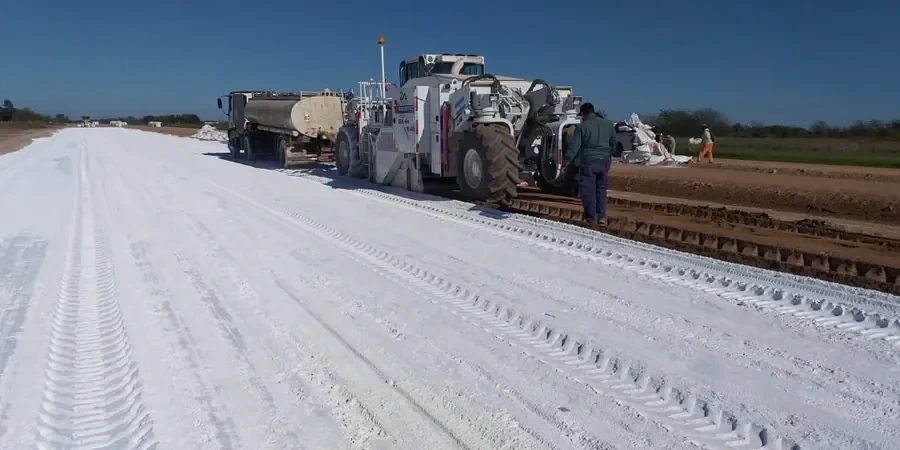
Treating the Keuper Marl with lime reduces its plasticity index from 35% to under 15% in most Birmingham projects.
Scope of work in Birmingham
Critical ground factors in Birmingham
The biggest risk we see in Birmingham is underestimating the heterogeneity of the glacial till. One test pit might show low-plasticity clay, but ten metres away you hit a seam of high-plasticity Marl with sulphates. If you apply a standard cement mix without checking sulphate content, the stabilised layer can swell and crack within months. We always run a sulphate test on every batch of soil before finalising the binder. Another common issue is wet weather during construction — the Midlands clay holds water, and if you compact above optimum moisture content, you lose strength. Timing the operation between rain events is critical, and we coordinate closely with the contractor's programme.
Our services
We offer the full range of lime and cement stabilization services for Birmingham — from laboratory mix design to field verification.
Mix Design & Laboratory Testing
We determine the optimum binder type and dosage based on Atterberg limits, sulphate content, and compaction characteristics. Samples are cured and tested for unconfined compressive strength at 7 and 28 days.
Field Application Supervision
Our technicians oversee the spreading, mixing, and compaction of the stabilised layer. We monitor moisture content in real time and adjust the binder rate if the material varies from the design.
Quality Control Testing
After compaction we run field density tests (sand replacement or nuclear gauge), take cores for laboratory strength verification, and issue a signed compliance report against the project specification.
Q&A
When should I choose lime over cement for stabilization in Birmingham?
Lime is preferred when the soil has a plasticity index above 25% and high moisture content — typical of the Keuper Marl. Lime reduces plasticity and dries the soil, making it workable. Cement works better on lower-plasticity soils where you need rapid strength gain, such as for temporary haul roads on construction sites around the M6 corridor.
How long does the lime and cement stabilization process take from start to finish?
For a typical 500 m² area in Birmingham, the design and laboratory phase takes 7-10 working days. Field application — mellowing, mixing, compaction, and curing — takes another 5-7 days depending on weather. The total turnaround is roughly 2-3 weeks before the stabilised layer is ready to receive asphalt or concrete.
What is the typical cost range for lime and cement stabilization per square metre?
The cost ranges from £660 to £1,950 for a standard 500 m² area, depending on binder type, depth of treatment, and site access. This includes laboratory mix design, field supervision, and quality control testing. Larger volumes reduce the per-square-metre rate.
Can I build directly on the stabilised soil, or do I need a capping layer?
In most Birmingham projects, a 150 mm capping layer of granular material is placed on top of the stabilised subgrade. The stabilised layer provides a uniform, high-CBR platform (typically 15% or more), but the capping protects it from construction traffic and freeze-thaw cycles. We can advise on the exact thickness based on your traffic loading and the design CBR.