The rapid expansion of Birmingham during the Industrial Revolution shaped much of its current layout, with canals and railways cutting through glacial till and river terrace deposits. These legacy earthworks demand careful geotechnical consideration. We apply MSE wall design to reinforce unstable slopes and retain fill in constrained urban sites, working to Eurocode 7 (EN 1997-1:2004) and BS 5930. Before finalizing reinforcement layouts, we often combine this with a geotechnical drainage assessment to control pore pressure behind the wall face.
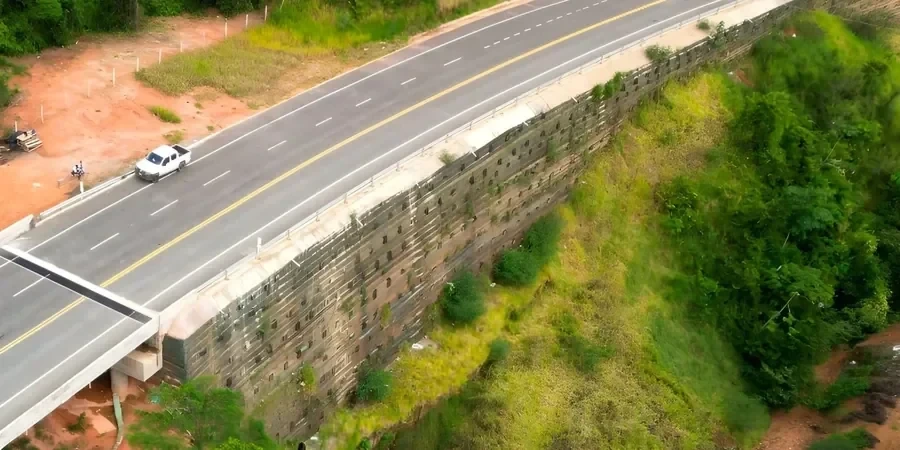
For MSE walls on Birmingham's Keuper Marl, we require an interface friction angle measured via direct shear on saturated samples to avoid overestimating pullout capacity.
Scope of work in Birmingham
- Geogrid tensile strength at 2% and 5% strain
- Soil-geosynthetic interface friction angle
- Global stability factor of safety (minimum 1.5 per Eurocode 7)
- Allowable bearing pressure below the reinforced block
- Long-term creep and durability under UK climatic cycles
Live process video
Critical ground factors in Birmingham
A common mistake we see in Birmingham is assuming MSE wall design is interchangeable with conventional cantilever walls. Contractors sometimes skip the interface shear test between backfill and geogrid, leading to underestimated pullout forces. On a recent project near the M6, this oversight caused 40 mm of lateral displacement within six months. Without proper reinforcement detailing and drainage, the retained soil can bulge or settle differentially. We always verify the reinforced soil mass behaves as a coherent gravity block before signing off.
Our services
Our MSE wall design service covers both preliminary feasibility and detailed construction drawings. We tailor each solution to the local ground conditions in Birmingham.
Reinforced Soil Wall Design & Detailing
We produce full reinforcement layouts, including geogrid type selection, wrap-around facing, and connection details. Our designs include internal, external, and global stability checks per Eurocode 7, with specific attention to Birmingham's mixed geology of cohesive and granular fills.
Seismic & Dynamic MSE Assessment
For infrastructure near rail or highway corridors, we evaluate pseudo-static seismic loads and dynamic compaction effects. This includes selecting appropriate acceleration coefficients for the West Midlands region and checking overturning resistance under peak ground accelerations up to 0.12 g.
Q&A
What soil types in Birmingham are suitable for MSE walls?
Granular soils with less than 15% fines by weight are ideal. In Birmingham, river terrace sands and gravels work well, while Keuper Marl requires stabilization or replacement of the upper 500 mm. We always verify via direct shear and compaction tests before specifying backfill.
How long does an MSE wall design take for a typical Birmingham site?
For a wall up to 8 m high on flat terrain, expect 4 to 6 weeks from soil testing to final drawings. Complex sites with sloping ground or groundwater may take 8 to 10 weeks. We parallelize the lab testing and design phases to reduce overall project time.
What is the cost range for MSE wall design in Birmingham?
Design fees typically range between £1,100 and £4,110 depending on wall height, number of reinforcement layers, and site complexity. This includes stability analysis, material specification, and a construction-ready drawing package. Additional charges apply for seismic checks or groundwater modelling.