Birmingham sits on a complex mix of Triassic sandstone, Mercia Mudstone, and glacial till, with groundwater levels often fluctuating within 3–5 m of the surface. These conditions demand careful road embankment design to prevent long-term settlement and slope instability. Our team combines In-Situ with laboratory analysis to define shear strength and consolidation parameters. For projects requiring deeper profiling, we integrate MASW-Vs30 surveys to map stiffness contrasts across the embankment footprint. Every design follows Eurocode 7 (EN 1997-1:2004) limit-state principles, ensuring both serviceability and ultimate stability under Birmingham’s variable loading scenarios.
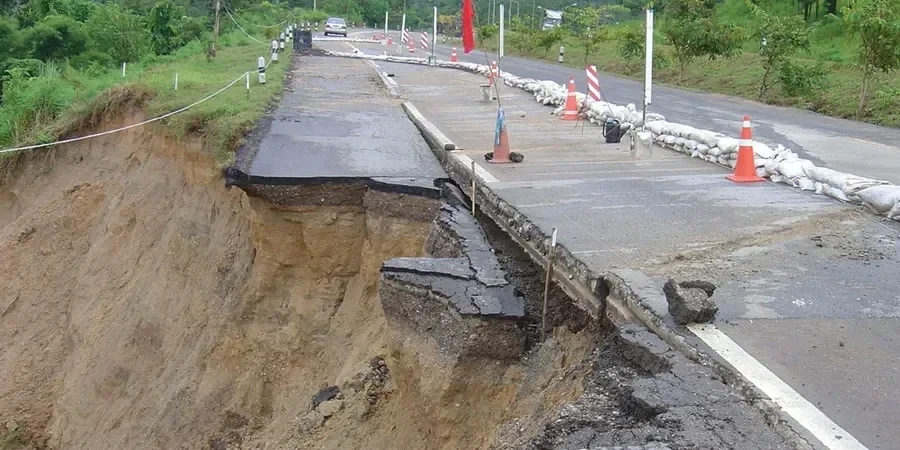
Weathered Mercia Mudstone can lose 40% of its undrained strength within two years if embankment drainage is not designed correctly.
Scope of work in Birmingham
- Pre-construction CBR testing to determine subgrade strength
- Consolidation modelling with oedometer data from undisturbed samples
- Slope stability analysis using Bishop’s method for both short- and long-term conditions
Live process video
Critical ground factors in Birmingham
Birmingham’s temperate maritime climate brings over 700 mm of annual rainfall, concentrated in winter months. This saturates clay fills, reducing effective stress and triggering progressive slope failures. The risk is highest along embankments built on the city’s south-eastern glacial till, where perched water tables develop rapidly after prolonged rain. Without a dedicated drainage layer and controlled compaction, pore pressures can exceed design assumptions within a single wet season. Our designs incorporate under-drainage blankets and geotextile separators to manage this – a practice proven on the M6 and M42 corridor works.
Our services
We offer a full suite of services to support road embankment design in Birmingham, from ground investigation to construction verification.
Ground Investigation & Laboratory Testing
Boreholes, trial pits, and undisturbed sampling combined with triaxial compression, consolidation, and CBR testing to provide design parameters for embankment stability and settlement.
Slope Stability & Settlement Analysis
Limit-equilibrium and finite-element modelling using Bishop, Spencer, and Mohr-Coulomb models to evaluate long-term factors of safety and differential settlement under Birmingham’s ground conditions.
Compaction Control & Fill Certification
On-site density testing (sand replacement, nuclear gauge), moisture conditioning, and Proctor compaction verification to ensure fill meets specification and avoids post-construction distress.
Q&A
What is the typical cost range for a road embankment design study in Birmingham?
For a standard embankment up to 8 m high, the study typically costs between £890 and £3,210, depending on the number of boreholes, laboratory tests, and analysis complexity. Larger or more complex schemes may fall outside this range.
How does Mercia Mudstone affect embankment design compared to other clay soils?
Mercia Mudstone is a weak, fissured mudrock that can lose strength rapidly when exposed to water. Its relict joints and variable weathering require careful drainage design and staged construction to prevent progressive failure. Standard clay models often underestimate its creep behaviour.
What factor of safety is acceptable for a road embankment in Birmingham?
Eurocode 7 and DMRB CD 225 require a minimum factor of safety of 1.4 for long-term stability under drained conditions, and 1.2 for short-term (undrained) cases. For critical infrastructure or high-traffic routes, we typically aim for 1.5 or higher.