In Birmingham we see it time and again: a development on the edge of the Lickey Hills or along the Rea Valley starts with a promising cut, then the first heavy rain reveals a slip plane nobody modelled. That is why our slope stabilization design in Birmingham always begins with a thorough ground model, not just a calculation. We combine walkover surveys with boreholes and In-Situ to map soil fabric and groundwater conditions before we run limit-equilibrium analyses. For projects on the Birmingham Fault zone, we also recommend a complementary geotechnical drainage study to intercept perched water tables that often trigger failures in the Mercia Mudstone.
Understanding the local stratigraphy from till to Mercia Mudstone is the foundation of every reliable slope design in Birmingham.
Scope of work in Birmingham
Critical ground factors in Birmingham
Eurocode 7 demands that we consider three design situations for any slope: persistent, transient, and accidental. In Birmingham the transient case — heavy winter rainfall saturating the Keuper Marl — is the one that catches developers out most often. We run long-term drained analyses with pore-pressure ratios set to 0.3 to 0.4, and we always check the residual strength envelope because once a pre-existing shear surface forms, the cohesion drops to almost zero. Ignoring that can turn a minor regrade into a full remedial scheme costing five figures.
This service complements our laboratory testing work for a complete project analysis.
Our services
We deliver targeted services that cover the whole workflow from ground investigation to final design recommendations.
Geotechnical Site Investigation for Slopes
Boreholes, trial pits, and In-Situ (SPT, shear vane, permeability) to build a stratigraphic model and obtain undisturbed samples for lab strength testing.
Limit-Equilibrium & Numerical Analysis
2D slope stability analysis using SLIDE and Plaxis 2D; we model circular and non-circular slip surfaces, apply partial factors per Eurocode 7, and check seismic coefficients where relevant.
Remediation Design & Monitoring
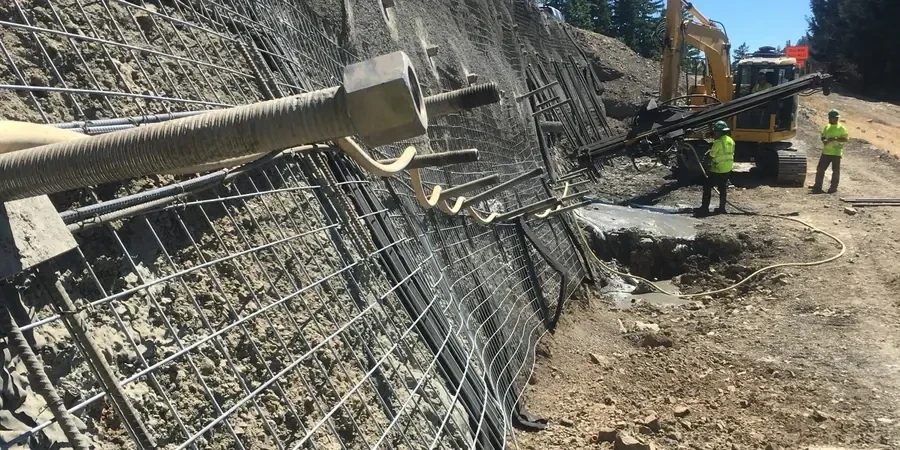
Design of drainage blankets, soil nailing, anchored walls, or regrading schemes. We also set up inclinometers and piezometers for post-construction performance verification.
Q&A
How much does a slope stabilization design in Birmingham typically cost?
For a typical residential or small commercial slope in the Birmingham area, the design fee including site visit, analysis, and report ranges between £1.220 and £4.330 depending on slope height, complexity of ground conditions, and the scope of remediation options required. Ground investigation costs are additional and depend on the number of boreholes.
What soil conditions in Birmingham are most problematic for slope stability?
The Mercia Mudstone (Keuper Marl) is the main troublemaker: it can appear firm when dry but loses significant strength upon wetting or unloading. Glacial till over sandstone also creates perched water tables that saturate the interface. We always check for relic shear surfaces in these materials.
Do you include groundwater monitoring in your slope design service?
Yes, we routinely install standpipe piezometers or vibrating-wire cells to record pore-pressure response over at least one wet season. Transient seepage analysis is then incorporated into the stability model to produce a realistic factor of safety for the design life.