Birmingham sits on a complex mix of glacial till (Boulder Clay), river terrace sands and gravels, and significant areas of made ground from its industrial past. The Birmingham Fault line runs roughly north–south, creating abrupt changes from stiff clays to weaker sandstones within a single site. For any earthworks or foundation platform, the Proctor test establishes the optimum moisture content and maximum dry density specific to the local soil. We apply both Standard (light) and Modified (heavy) compaction energy levels to match the expected construction loading, whether it is a highway embankment, a residential slab, or a deep fill for a commercial development.
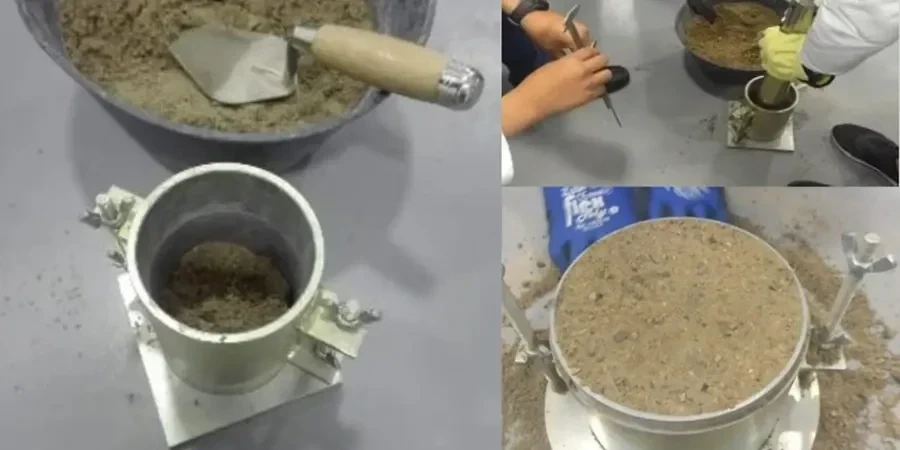
A Proctor test calibrated to Birmingham’s glacial till can prevent weeks of rework on a fill platform that fails density compliance.
Scope of work in Birmingham
Live process video
Critical ground factors in Birmingham
Birmingham’s temperate climate means rainfall is evenly distributed through the year, and the clay-rich tills retain water for long periods. If a Proctor test is performed on a sample that has already dried out during handling, the reported optimum moisture content will be lower than the field value, leading to a compaction specification that is impossible to achieve on a wet site. Conversely, testing an overly wet sample can underestimate the achievable density. The risk is that the contractor over-compacts to meet a false dry density target, causing the clay to become brittle or to lose strength over time. We therefore control moisture conditioning carefully in the laboratory and always report the sample’s initial water content alongside the test results.
Our services
We offer three compaction testing options tailored to Birmingham’s ground conditions and project scales.
Standard Proctor Test (BS 1377:Part 4)
Ideal for light to medium compaction requirements — residential fills, small embankments, and trench backfill. Uses the 2.5 kg rammer with three layers. Turnaround typically 3 working days.
Modified Proctor Test (BS 1377:Part 4)
Applies higher compactive effort (4.5 kg rammer, five layers) to simulate heavy roller compaction on highways, industrial yards, and deep fills. Required for higher density specifications in Birmingham’s commercial developments.
Oversize Correction & CBR-Compaction Combined
When the fill contains material >20 mm (common in Birmingham’s made ground), we apply the oversize correction per BS 1377. Can be combined with a CBR test on the same compacted sample to provide both density and strength data.
Q&A
What is the difference between Standard and Modified Proctor tests?
The Standard test uses a 2.5 kg rammer dropped from 300 mm, applying 596 kJ/m³ of energy. The Modified test uses a 4.5 kg rammer dropped from 450 mm, applying 2684 kJ/m³ — roughly 4.5 times more energy. The Modified test better simulates heavy construction equipment and is specified for highways and deep fills where higher density is required.
How much soil sample is needed for a Proctor test in Birmingham?
A minimum of 25 kg of representative material is recommended for the Standard test, and 35 kg for the Modified test. This allows for 5 to 6 moisture points plus a repeat if needed. For sites with gravel or cobbles, additional material may be required to account for oversize correction.
How long does a Proctor test take, and when will I get results?
The laboratory procedure itself takes 2 to 3 days, including drying and re-mixing between moisture points. We typically issue the report within 5 working days from sample receipt. Expedited service can be arranged for time-sensitive projects at an additional charge.
What is the typical cost range for a Proctor test in Birmingham?
The cost for a Standard Proctor test is between £90 and £140, while the Modified test ranges from £130 to £190. These figures include the compaction curve and a written report. Volume discounts apply for multiple samples from the same project.
Do you test soil from Birmingham’s made ground and colliery spoil?
Yes. Many brownfield sites in Birmingham contain industrial fill, slag, or colliery spoil. We can run the Proctor test on these materials provided the particle size is under 20 mm. For larger particles, we apply the oversize correction or recommend a trial embankment approach. The presence of coal or ash can affect optimum moisture, so we note any anomalies in the report.