Birmingham's geology is a mixed bag. You find glacial till over Mercia Mudstone in one spot, and river terrace gravels from the Rea valley just a street away. That variability makes the Standard Penetration Test a go-to tool for us. We use it to get a direct measure of soil resistance—blow by blow. Before we even start, we often pair this with a calicatas exploratorias to log the strata visually. The SPT then gives us the numbers to back up what we see in the pit. It is a practical, field-proven method that does not rely on lab assumptions.
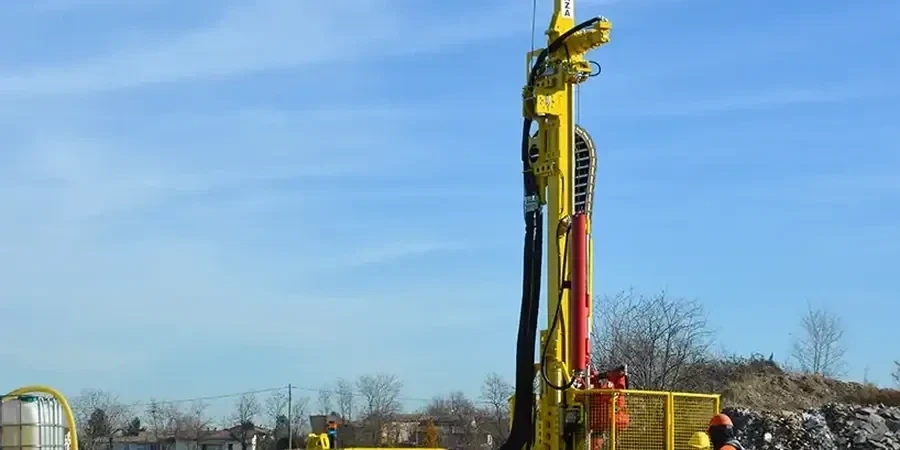
A single SPT blow count can tell you more about the ground than a week of lab testing on disturbed samples.
Scope of work in Birmingham
Critical ground factors in Birmingham
Eurocode 7 requires a cautious approach to ground parameters, and Birmingham's glacial tills can be deceptive. A loose lens within a stiff till layer might not show up on a single SPT. If you rely on one isolated test, you risk underestimating settlement. We always run SPTs at 1.5 m intervals and cross-check with adjacent boreholes. The biggest hazard in this city is the old mine workings—abandoned coal shafts that can cause sudden collapse. An SPT alone won't detect a void; you need a georradar-gpr for that. But the SPT does tell you if the ground above the void is competent or raveling.
This service complements our laboratory testing work for a complete project analysis.
Our services
We offer a full suite of SPT services tailored to Birmingham's ground conditions. Each service follows strict QA/QC protocols in our UKAS-accredited lab.
Standard SPT in boreholes
We perform SPT in rotary or cable percussion boreholes, recording N-values every 1.0 to 1.5 metres. Full energy correction is applied.
SPT with soil sampling
We retrieve disturbed samples from the split-spoon for classification tests like Atterberg limits and particle size distribution.
SPT for liquefaction assessment
We use the N-values to evaluate liquefaction potential following the NCEER (Youd-Idriss) method, critical for sites near watercourses.
SPT correlation services
We provide correlations from N-values to friction angle, relative density, and undrained shear strength for design parameters.
Q&A
How much does an SPT cost in Birmingham?
A standard SPT test in Birmingham typically costs between £490 and £690 per borehole, depending on depth, access, and number of tests required.
What is the difference between SPT N-value and CPT cone resistance?
The SPT N-value measures blows per 300 mm drive, giving a discrete point resistance. CPT cone resistance (qc) is a continuous profile measured in MPa. SPT is better for gravelly soils; CPT is faster in sands and clays.
Can SPT be done in gravel or cobbles?
Yes, but it is harder. In the river terrace gravels of Birmingham, we often see high blow counts (N > 50) and the test may be terminated early if refusal is reached. We note this as '50/150 mm'.
What corrections are applied to SPT N-values?
We apply corrections for hammer energy ratio (Er), rod length (Cr), borehole diameter (Cd), and overburden stress (CN). These follow BS 5930:2015 and Liao & Whitman (1986).
Is SPT suitable for shallow foundations design?
Absolutely. SPT gives direct N-values that correlate well with bearing capacity for shallow foundations in sands and gravels. For clays, we prefer to combine it with undrained shear strength from triaxial tests.